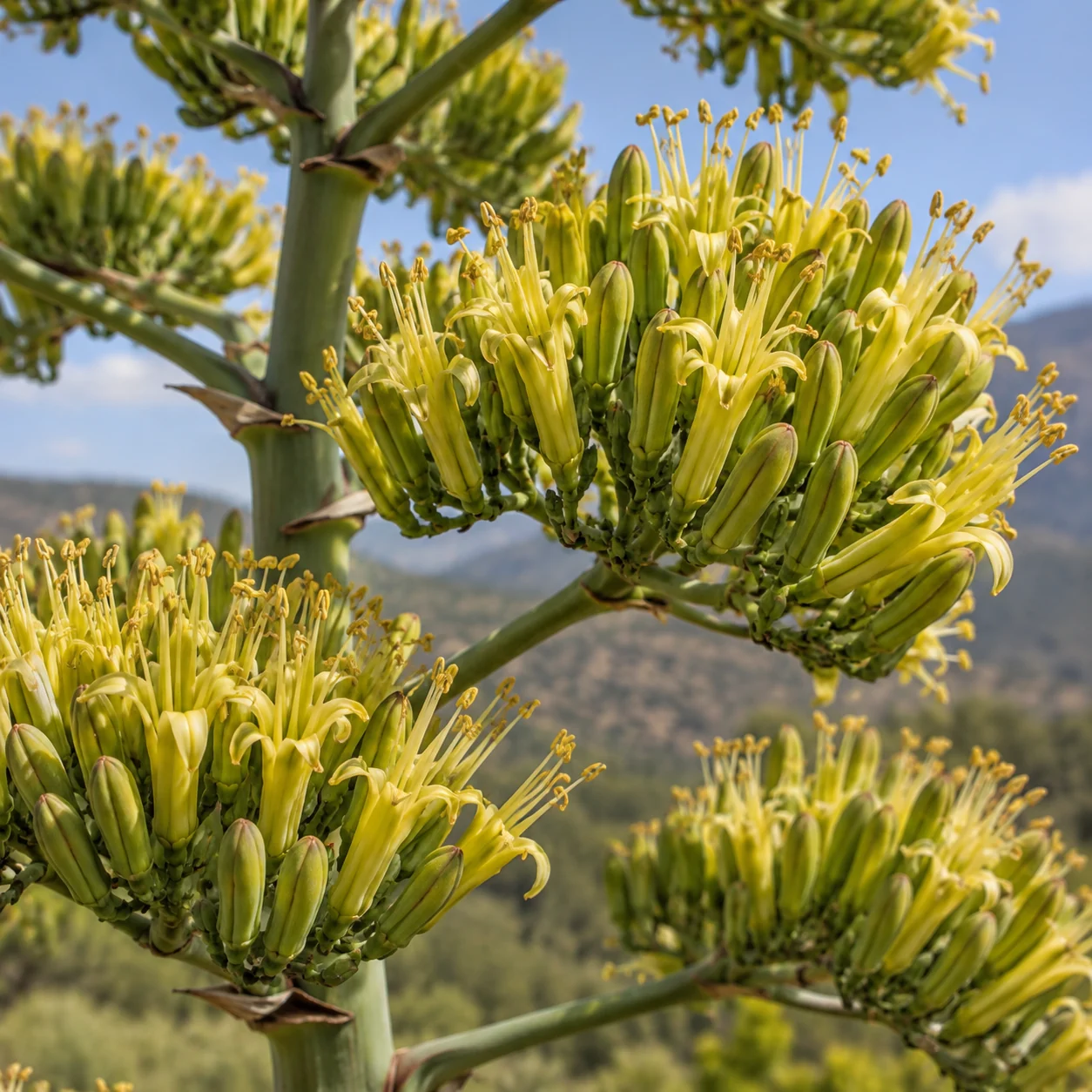
Agave sp. Part of an inflorescence
Part of a branched Agave sp. inflorescence. Open flowers and buds at different developmental stages are shown.
Illustrative image generated with AI and supplied by the website author.
Enlarge plate ↗Rosette and water storage
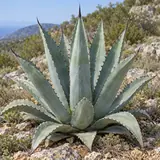
Most agaves familiar from cultivation have a short stem surrounded by persistent, fibrous leaves. Their thick blades store water, while the margins may carry teeth or fibres or remain smooth. Some species also lack a terminal spine. Rosette dimensions, leaf shape and armature are considered together with floral structure because a single feature can occur in several distantly related lineages. [Eguiarte et al. 2021] [Jiménez-Barron et al. 2020]
Succulent agaves assimilate carbon through CAM metabolism. Much of the uptake of carbon dioxide through the stomata occurs at night, allowing its subsequent use in photosynthesis with less daytime stomatal opening. Together with the water stored in leaves, this supports activity during periods of drought. Individual species nevertheless occupy a broad range of rainfall and temperature regimes, with the centre of their diversity in Mexico. [Eguiarte et al. 2021]
Flowering rosettes and clonal persistence
In many species, the apical meristem, the growth zone at the shoot tip, develops into an inflorescence. After reproduction, that rosette gradually dies. It is described as monocarpic because it flowers once in its lifetime. The genus also includes repeatedly flowering agaves, including members of the Agave striata group, whose different developmental pattern is reflected in their life cycle. [Eguiarte et al. 2021] [Jiménez-Barron et al. 2020]
Basal offsets, rosettes arising from rhizomes and plantlets on an inflorescence can prolong the persistence of the same clone. A clone comprises generations of rosettes with the same or very similar genotype. The death of a flowering rosette can therefore occur while its vegetative descendants continue growing. In some ancient cultivated agaves, this mode of reproduction has sustained lineages for centuries. [Eguiarte et al. 2021] [Hodgson et al. 2023]
Flowers and pollinators
Inflorescences provide animals with large quantities of nectar and pollen. Nectar-feeding Leptonycteris bats are important pollinators of many Mexican species. Birds and insects also visit the flowers, and their relative importance varies among species, populations and years. In many studied agaves, the anthers release pollen before the stigma becomes receptive. This protandry reduces the opportunity for self-pollination within the same flower. [Eguiarte et al. 2021]
Relationships and the circumscription of the genus
Modern studies use a broad circumscription of Agave that includes plants formerly described under Manfreda, Polianthes and Prochnyanthes. A study published in 2020 compared chloroplast markers with the nuclear ITS region. ITS distinguished more lineages, whereas the low variation in the chloroplast DNA regions limited tree resolution. These findings explain why the traditional division by broad and narrow inflorescences requires assessment using molecular data. [Jiménez-Barron et al. 2020] [Eguiarte et al. 2021]
Principles of container cultivation
Container cultivation begins with good light, ventilation and free-draining growing medium. Excess water should drain freely. Watering follows active growth and is reduced during a cool resting period. Spring repotting is appropriate once roots have filled the pot. Overwintering and propagation practices are selected for the individual species. [1-WWW]