Branching and relationships
Traditional agave classifications placed considerable weight on inflorescence appearance. Plants with broadly branched panicles were separated from those whose flowers were concentrated nearer the main axis. This feature describes the plant, while its value for identifying relationships is assessed against an evolutionary tree. In 2020, Jiménez-Barron and colleagues compared several chloroplast DNA regions with nuclear ITS, sampling broadly circumscribed Agave and related genera. [Jiménez-Barron et al. 2020] [Eguiarte et al. 2021]
The two data sets differed in their information content. The combined chloroplast regions contained few variable sites, limiting reconstruction resolution. ITS distinguished some lineages more clearly. Several lineages included species with both broad and narrow inflorescences, suggesting repeated changes in flower arrangement during evolution. Interpretation requires attention to marker choice, species sampling and the limited support for some branches. [Jiménez-Barron et al. 2020]
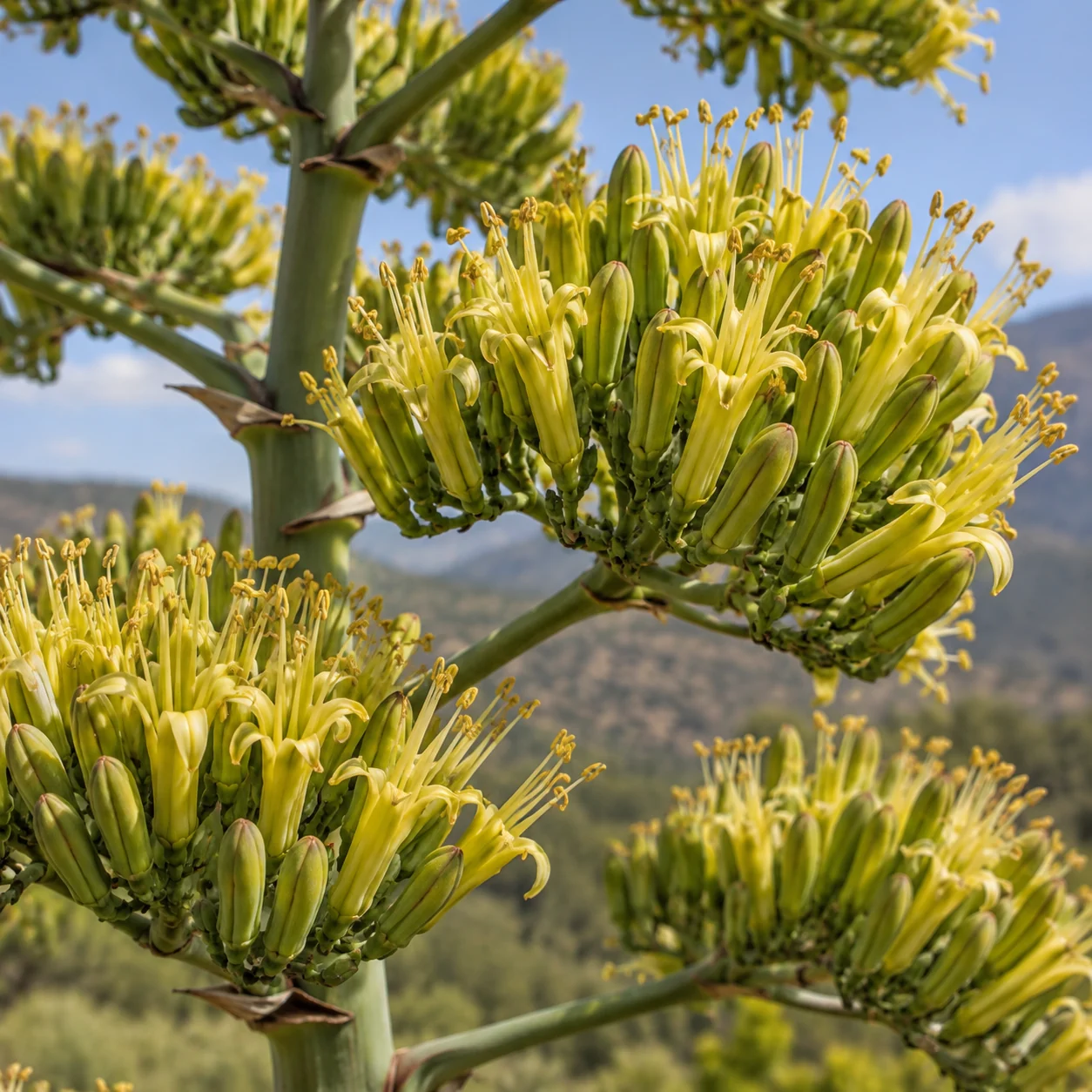
Agave sp. Part of an inflorescence
Part of a branched Agave sp. inflorescence. Open flowers and buds at different developmental stages are shown.
Illustrative image generated with AI and supplied by the website author.
Enlarge plate ↗A large inflorescence as a resource
Many flowers provide an abundant source of nectar and pollen. Nectar-feeding Leptonycteris bats are important pollinators in many Mexican populations, transferring pollen as they move among inflorescences. Agaves are also visited by hummingbirds, other birds and insects, including moths and bees. Eguiarte and colleagues emphasize variation in these relationships among species, sites and years. The importance of an animal as a pollinator is assessed through its contribution to pollen transfer and reproductive success. [Eguiarte et al. 2021]
In many studied agaves, anthers mature before the stigma becomes receptive. This temporal separation is called protandry and reduces self-pollination within a flower. Pollen can still arrive from another flower on the same inflorescence, so animal movements among different plants also matter. Comparing floral timing with pollinator movement provides a more precise account of opportunities for gene flow. [Eguiarte et al. 2021]
The cost of a single flowering event
In most typical rosette-forming agaves, the inflorescence develops from the shoot apex and the flowering rosette subsequently dies. A review of the genus discusses the hypothesis that more flowers and greater nectar production increased the benefits of attracting pollinators. Selection could then favour a large reproductive investment concentrated in one season. This evolutionary interpretation is considered together with resource allocation, meristem development and plant survival. [Eguiarte et al. 2021]
Different life cycles help distinguish associations among traits from a simple causal explanation. Agave striata can retain its rosette after flowering, and species in different lineages use several pollinator groups. Meanwhile, offsets allow many agaves to maintain a clone after the flowering rosette dies. Inflorescence size, the fate of one rosette and the persistence of the vegetative lineage therefore describe different levels of the same plant’s biology. [Eguiarte et al. 2021] [Jiménez-Barron et al. 2020]
Flowering and the maintenance of diversity
In agaves grown for harvest, rosettes are often collected before flowering. Allowing some plants to flower supplies resources to animals and creates opportunities for seed production. The 2021 review describes initiatives linking pollinator conservation with the maintenance of agave genetic diversity. The proportion retained for reproduction depends on the species, planting density and management system. Its biological purpose is to maintain the complete cycle of flowering, pollination and the development of a new generation. [Eguiarte et al. 2021]
Phylogeny, Diversification Rate, and Divergence Time of Agave sensu lato (Asparagaceae), a Group of Recent Origin in the Process of Diversification
Jiménez-Barron O., García-Sandoval R., Magallón S., García-Mendoza A., Nieto-Sotelo J., Aguirre-Planter E., Eguiarte L. E., Phylogeny, Diversification Rate, and Divergence Time of Agave sensu lato (Asparagaceae), a Group of Recent Origin in the Process of Diversification, Frontiers in Plant Science, 2020, 11:536135, doi: 10.3389/fpls.2020.536135
A phylogenetic analysis of broadly circumscribed Agave compares chloroplast markers with nuclear ITS. The authors reconstruct relationships, diversification and inflorescence evolution, noting the limited resolution of some data.
Evolutionary ecology of Agave: distribution patterns, phylogeny, and coevolution (an homage to Howard S. Gentry)
Eguiarte L. E., Jiménez B. O. A., Aguirre-Planter E., Scheinvar E., Gámez N., Gasca-Pineda J., Castellanos-Morales G., Moreno-Letelier A., Souza V., Evolutionary ecology of Agave: distribution patterns, phylogeny, and coevolution (an homage to Howard S. Gentry), American Journal of Botany, 2021, 108(2):216-235, doi: 10.1002/ajb2.1609
This review connects agave distribution and drought adaptations with phylogeny, pollination biology and population genetics. It discusses research history, clonal propagation, past and present uses, and conservation of agaves and their pollinators.
