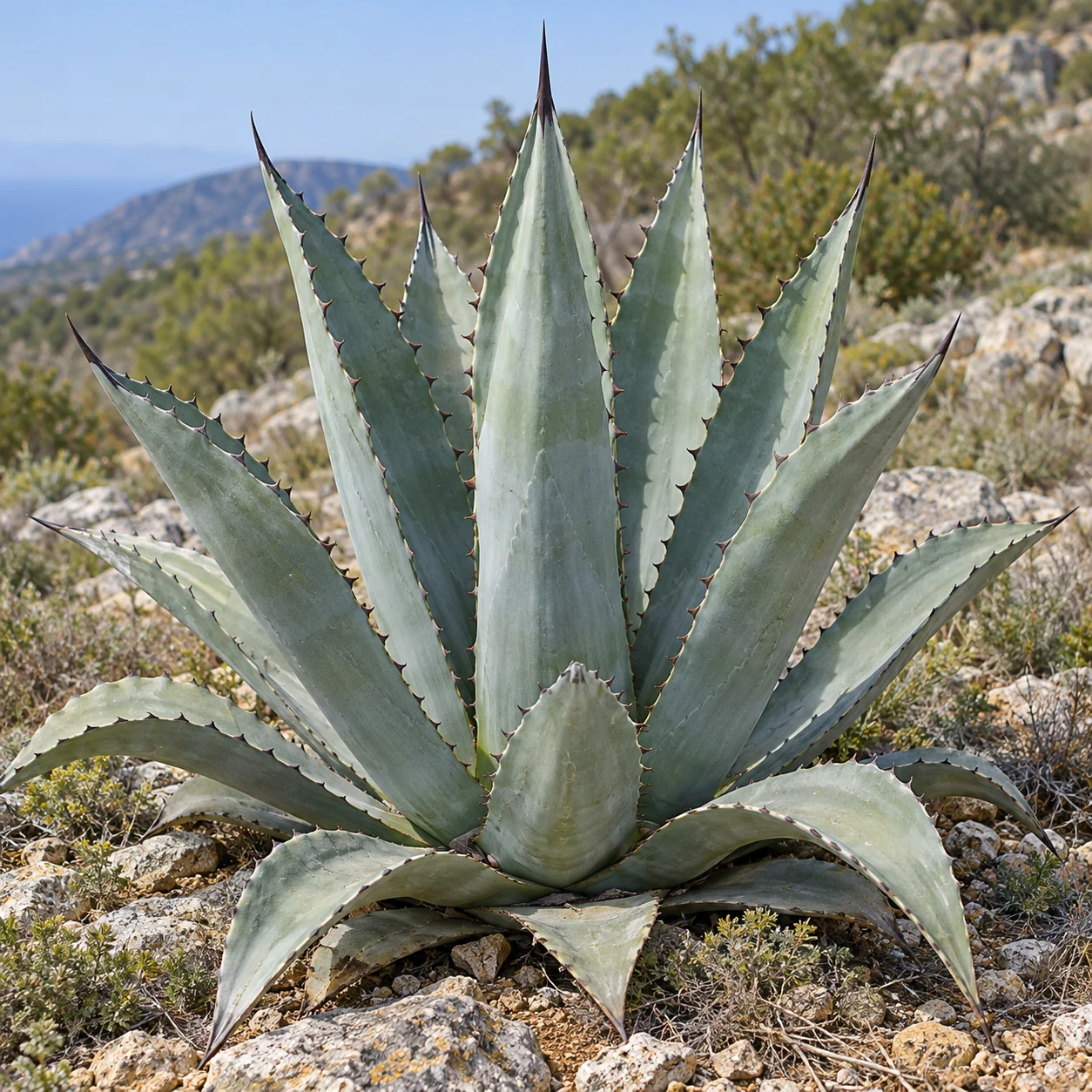
Agave americana. Leaf rosette
Rosette of fleshy Agave americana leaves. The leaf margins bear teeth and the tips carry dark terminal spines.
Illustrative image generated with AI and supplied by the website author.
Enlarge plate ↗Habit and inflorescence
Flora of North America describes green or grey-green leaves 80–200 cm long and 15–25 cm wide. The terminal spine measures 2–6 cm. The flowering stalk reaches 5–9 m, with yellow flowers borne on its branches. Pollination is followed by capsules containing seeds. These are descriptive ranges for the species as treated in that flora. [Reveal and Hodgson 2002]
Names and origin
Plants of the World Online accepts Agave americana L. within Asparagaceae. In the atlas, the accepted name links to the existing synonyms and infraspecific taxa. The distribution of cultivated and naturalized plants has a different history from the native range. A review of agave ecology discusses their introduction elsewhere and their potential to become invasive in dry environments. [2-WWW] [Eguiarte et al. 2021]
Water, development and relationships
The thick leaves provide long-term storage of water and resources accumulated during growth. In succulent agaves, CAM metabolism involves nocturnal carbon dioxide uptake and efficient water use. Developing a tall inflorescence requires a major investment of stored resources. A review of the genus relates this investment to inflorescence size, flower number and the reproductive benefits associated with pollinator visits. This provides a comparative context for agave biology. [Eguiarte et al. 2021]
In a phylogenetic study published in 2020, Agave americana belonged to one of the younger Agave sensu stricto lineages, alongside species including Agave deserti and Agave tequilana. Strongly branched inflorescences predominated in this group. The authors presented this as a reconstruction based on a particular set of DNA markers. Its value lies in comparing trait evolution across lineages while retaining uncertainty in some relationships. [Jiménez-Barron et al. 2020]
Cultivation
RHS recommends bright, filtered light under glass and a standard cactus growing medium. Watering is moderate during growth, and the medium is kept almost dry in winter. Propagation uses offsets removed in spring or autumn. Gloves protect against spines and irritating sap when handling the plant. [1-WWW]
Related articles
Materials from the author's archive
The species also appears in Konrad Szychowski's private material archive. [Anonim n.d.u] [Kaktusy i Inne 2005b]