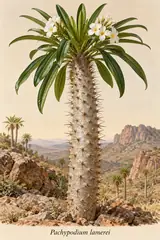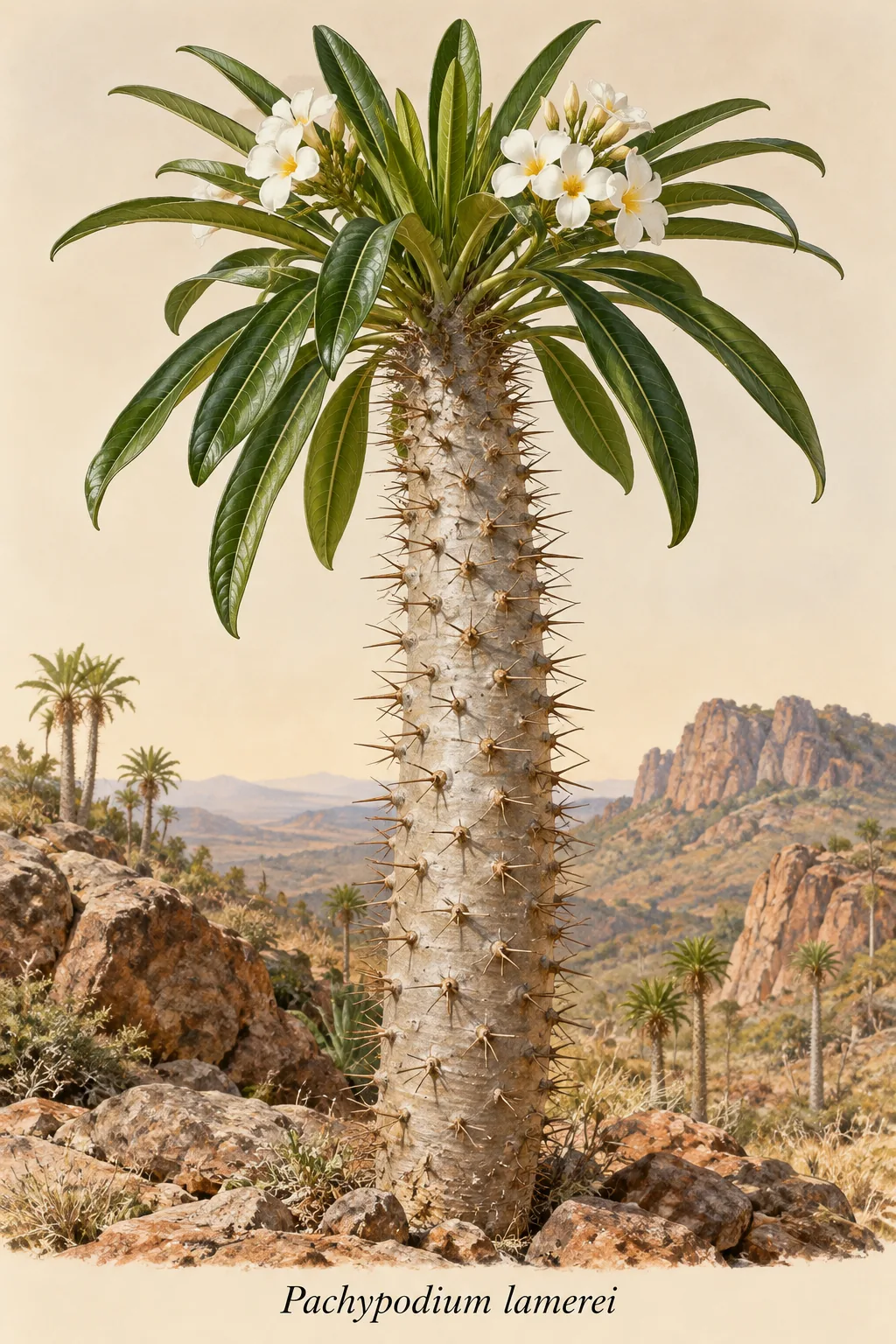
Pachypodium lamerei. Stem and leaf crown
Habit of Pachypodium lamerei with a crown of leaves and flowers at the shoot apex.
Illustrative depiction supplied by the site author.
Enlarge plate ↗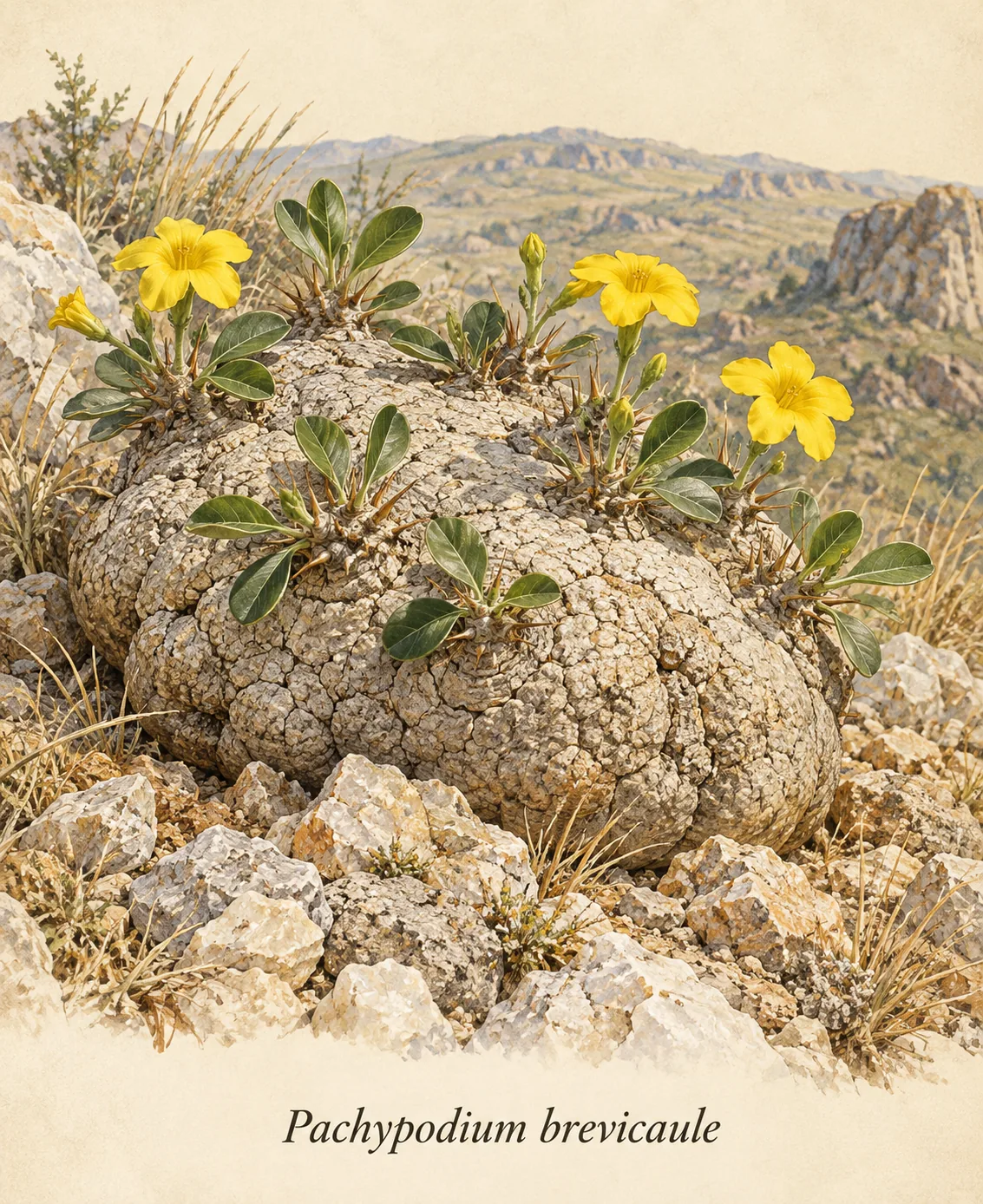
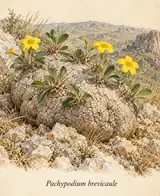
Pachypodium brevicaule. Low growth form and yellow flowers
The low, expanded stem of Pachypodium brevicaule with leaves and yellow flowers.
Illustrative depiction supplied by the site author.
Enlarge plate ↗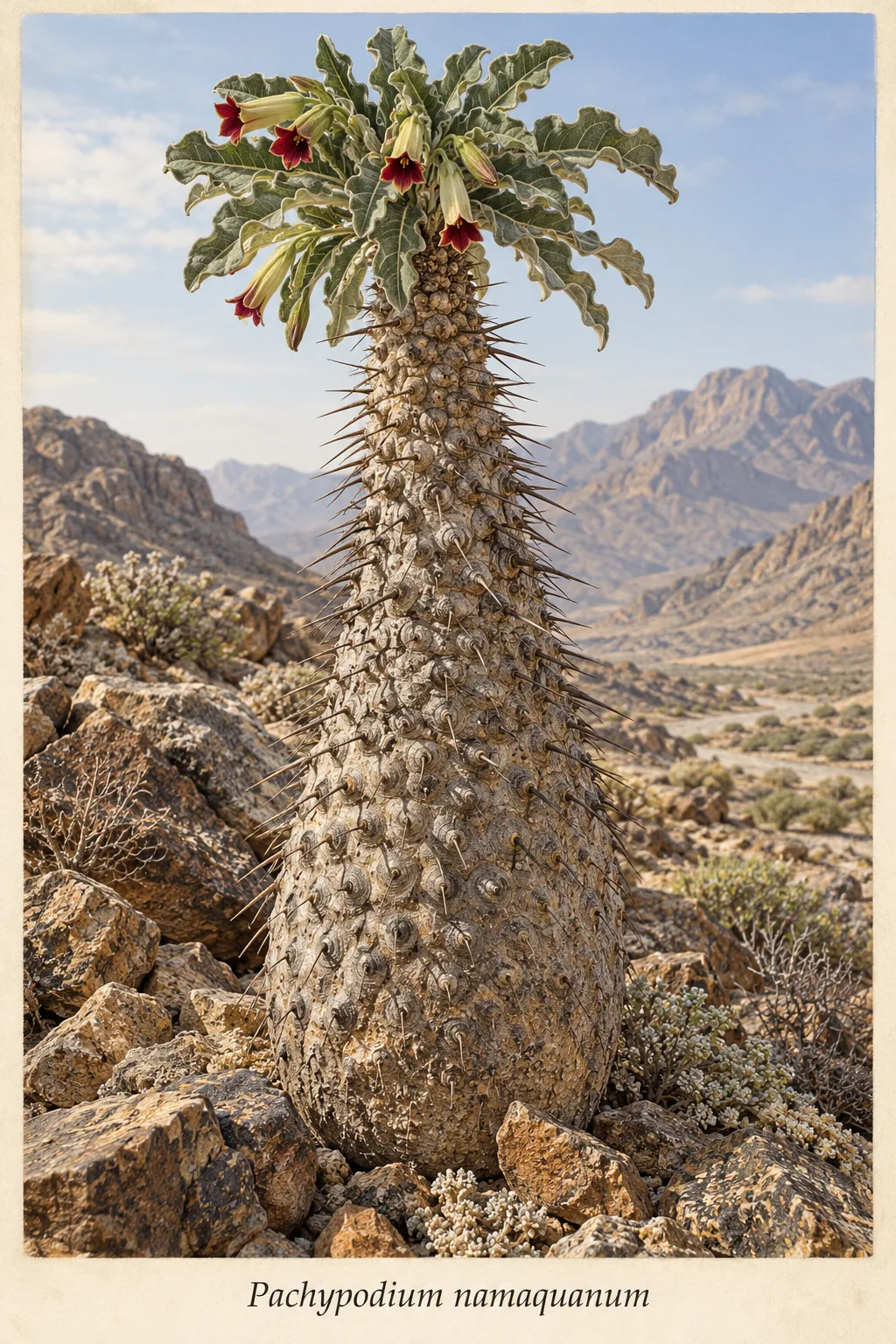
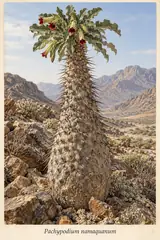
Pachypodium namaquanum. Spiny stem
Pachypodium namaquanum with a markedly thickened stem and leaves clustered near the apex.
Illustrative depiction supplied by the site author.
Enlarge plate ↗Stems, leaves and spines
The thickened plant axis stores water. In low-growing representatives it is described as a caudex. In tree species, the same broad strategy involves a swollen trunk. Size and branching vary considerably among species. Pachypodium brevicaule spreads close to the rock surface, whereas Pachypodium lamerei develops an upright trunk and crown. [Lüthy 2004]
The leaves are simple and alternate. Lateral spines at the leaf base represent modified stipules. In some species they are accompanied by additional axillary structures. In Pachypodium lamerei, two lateral spines may flank a third, central spine. Paired spines predominate in the Malagasy shrubs of the Pachypodium rosulatum group. Spine number is considered together with leaf, flower and fruit characters. [Lüthy 2004] [Burge et al. 2013]
Flowers and seeds
The fused petals form a tube ending in five lobes. Depending on the species, the stamens remain within the tube or extend beyond it. Corollas may be white, yellow, pink or red. Colour helps distinguish broader groups, while detailed identification also uses tube shape, stamen position and ovary pubescence. [Lüthy 2004] [Burge et al. 2013]
Pollination is followed by elongated fruits composed of two follicles. When these open, they release seeds bearing a tuft of hairs. Lüthy also compared seed dimensions and seed-coat sculpture. These characters allow comparisons among plants with markedly different growth forms and reveal similarities beyond trunk shape. [Lüthy 2004]
Relationships between Africa and Madagascar
In 2013, Burge and colleagues compared the nuclear ITS region and chloroplast trnL-F. Their material comprised 56 plants representing all 21 species and 27 minimum-rank taxa in the classification used at the time. The analyses recovered several distinct lineages, including an African group containing Pachypodium namaquanum, Pachypodium bispinosum and Pachypodium succulentum and a Malagasy group of low-growing species in section Gymnopus. [Burge et al. 2013]
The branching relationships among the major lineages remained poorly resolved. The authors therefore retained several possible scenarios connecting continental and Malagasy plants. The total of 21 species defines the scope of the 2013 study. The atlas nomenclature follows the currently verified POWO names. [Burge et al. 2013]
Water storage and photosynthesis
Physiological studies of Pachypodium brevicaule, Pachypodium horombense and Pachypodium lamerei found carbon assimilation consistent with C3 photosynthesis in the tested plants. In the same study, Euphorbia trigona combined C3 leaves with a CAM stem. The comparison links similar succulent growth forms with different rhythms of carbon uptake. Its conclusions apply to the named species and experimental conditions. [Eder et al. 1981]
Cultivation according to plant activity
SANBI recommends good light and ventilation, particularly under glass. It relates watering during growth to the species and plant size. In cultivation, watering therefore follows leaf development and shoot activity. Pachypodium namaquanum follows the cooler season in its South African habitat, whereas European cultivation guidance for Pachypodium lamerei concentrates watering in the warmer part of the year. [18-WWW] [18-WWW] [1-WWW]
Related articles
Synonyms and names in the literature
Belonites [2-WWW]