Acanthocalycium hoevenii. Globular stem and spines
Illustrative depiction of Acanthocalycium hoevenii from the supplied collection.
AI-generated illustration supplied by the site author.
Enlarge plate ↗
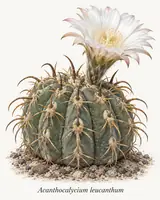
Acanthocalycium leucanthum. Stem with a white flower
Illustrative depiction of Acanthocalycium leucanthum from the supplied collection.
AI-generated illustration supplied by the site author.
Enlarge plate ↗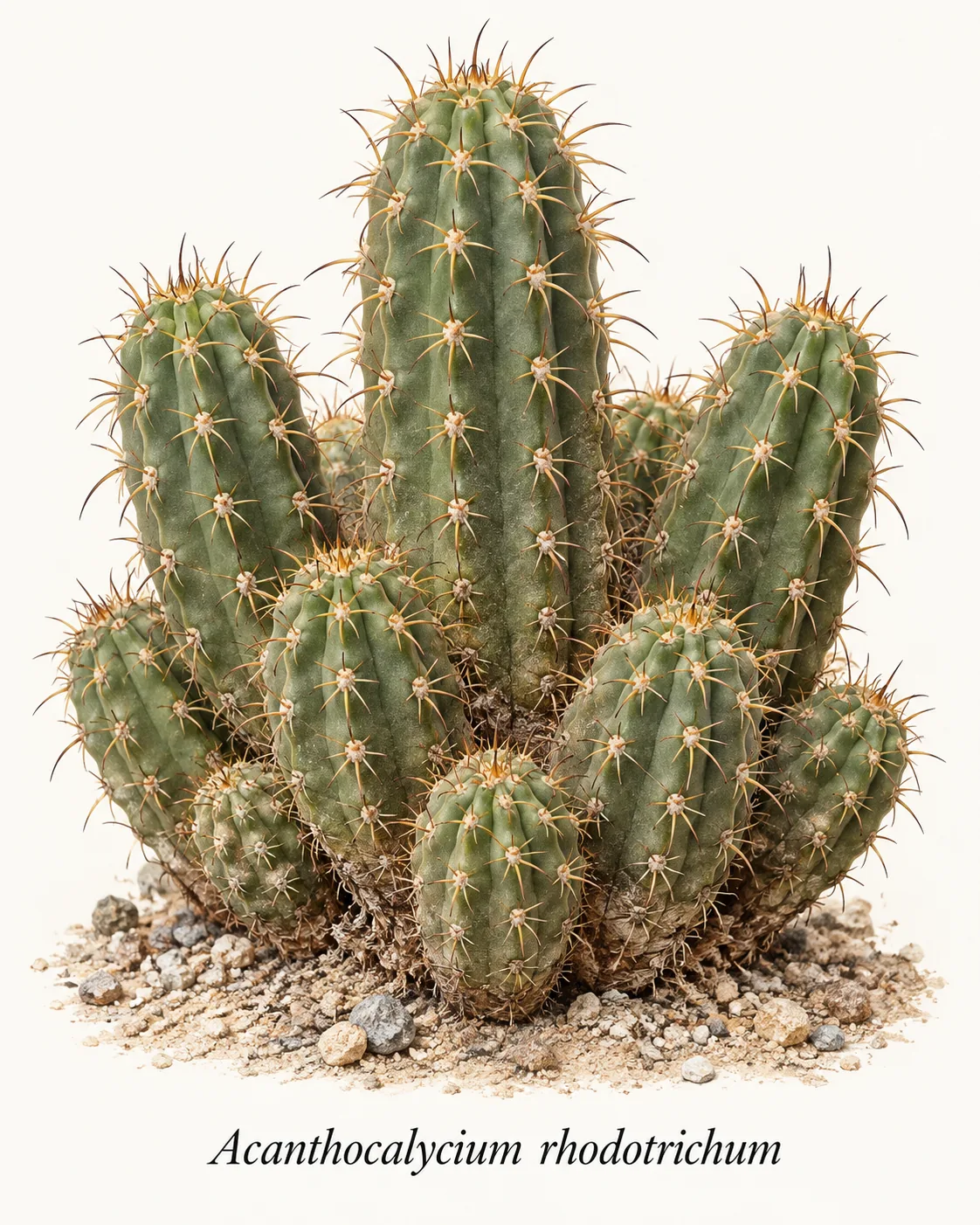
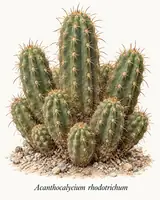
Acanthocalycium rhodotrichum. A group of elongated stems
Illustrative depiction of Acanthocalycium rhodotrichum from the supplied collection.
AI-generated illustration supplied by the site author.
Enlarge plate ↗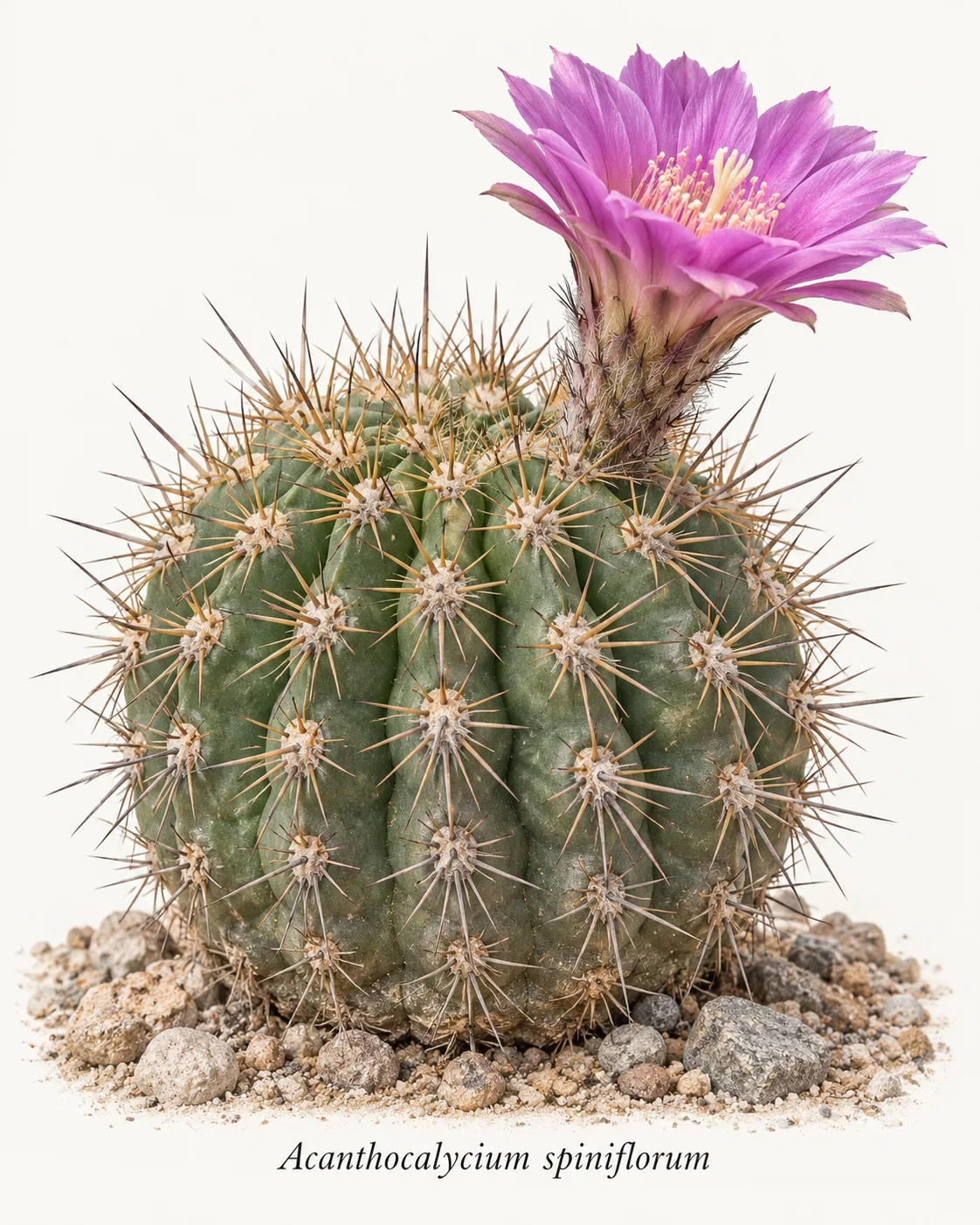
Acanthocalycium spiniflorum. Stem with a pink flower
Illustrative depiction of Acanthocalycium spiniflorum from the supplied collection.
AI-generated illustration supplied by the site author.
Enlarge plate ↗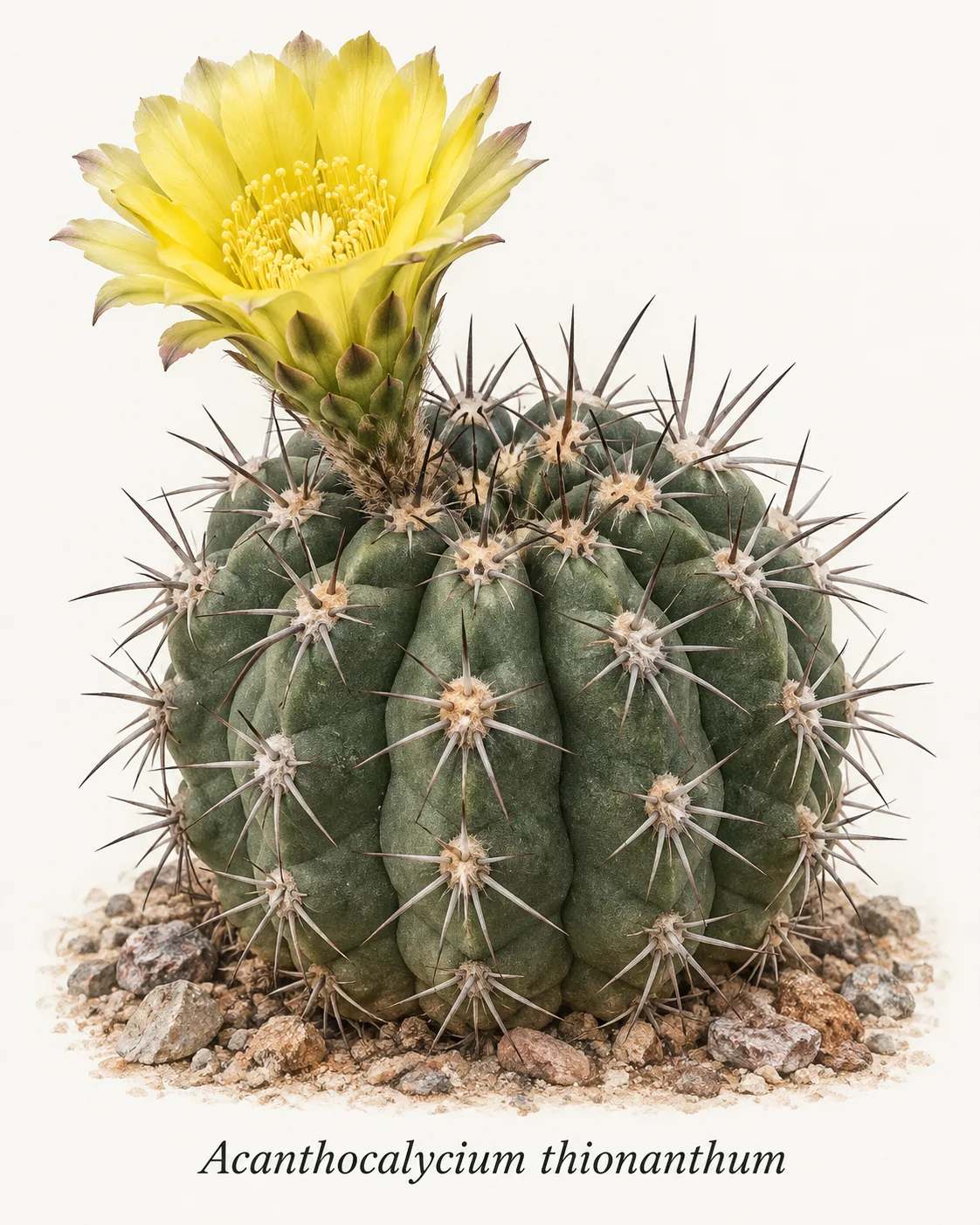
Acanthocalycium thionanthum. Stem with a yellow flower
Illustrative depiction of Acanthocalycium thionanthum from the supplied collection.
AI-generated illustration supplied by the site author.
Enlarge plate ↗Habit and flowers
Members of the genus have flattened, globose or short columnar stems. Ribs divide the stem surface and bear areoles, the specialized sites where spines and flowers develop. Acanthocalycium spiniflorum has a green ribbed stem with strong spines and produces pink, pale purple or white flowers in summer. Acanthocalycium rhodotrichum has white flowers with an elongated tube, remaining open into the morning after opening at night. [1-WWW] [Ferreira et al. 2018]
Relationships inferred from DNA
Schlumpberger and Renner compared three chloroplast DNA regions. In their phylogeny, material identified as Echinopsis leucantha fell within the group traditionally recognized as Acanthocalycium. This result places small daytime flowers and long nocturnal flowers within a closely related lineage. Floral form is associated with interactions with pollen-carrying animals and can change more readily than some characters inherited from a common ancestor. [Schlumpberger and Renner 2012]
The 2025 classification by de Vos and colleagues retains Acanthocalycium in subtribe Trichocereinae. Their nuclear-gene analysis found a close relationship with Setiechinopsis, differing in some details from the earlier chloroplast tree. The authors emphasized the importance of denser sampling in this group. Sampling representative species informs the genus’s position within the family, while the limits of individual species also require population and morphological evidence. [de Vos et al. 2025]
Habitats and reproductive rhythms
The genus includes plants of mountain valleys in northwestern Argentina, dry Monte shrublands and lower Chaco landscapes. In Acanthocalycium thionanthum populations near Angastaco, the first rains after the prolonged dry season preceded synchronized flower opening. The Acanthocalycium rhodotrichum studied in the Brazilian Chaco flowered for many months, with greater intensity in the wet season. Different environments and floral activity windows produce several reproductive schedules within the genus. [Eggli and Giorgetta 2017] [Ferreira et al. 2018] [Almirón and Martínez Carretero 2010]
Pollen compatibility and seed formation
Studied populations also differed in their reproductive systems. Experiments with Acanthocalycium leucanthum demonstrated self-incompatibility, limiting successful fertilization with its own pollen. In Acanthocalycium rhodotrichum, manually transferring self pollen produced fruits, whereas isolated flowers left without this treatment failed to set fruit. This separates compatibility between pollen and pistil tissues from spontaneous delivery of pollen to the stigma. Several flowers opening on one cultivated plant can therefore have different consequences according to species and material. The experimental findings remain assigned to their source populations. [Gorostiague and Ortega-Baes 2017] [Ferreira et al. 2018]
Recognizing names in collections
Echinopsis leucantha and Echinopsis rhodotricha correspond to the currently accepted Acanthocalycium leucanthum and Acanthocalycium rhodotrichum. Within Acanthocalycium spiniflorum, POWO also includes the former Acanthocalycium violaceum, Acanthocalycium klimpelianum and Acanthocalycium peitscherianum. A label carrying the locality and field number remains valuable because it preserves the identity of particular material after a change in generic name. [2-WWW] [2-WWW] [2-WWW]