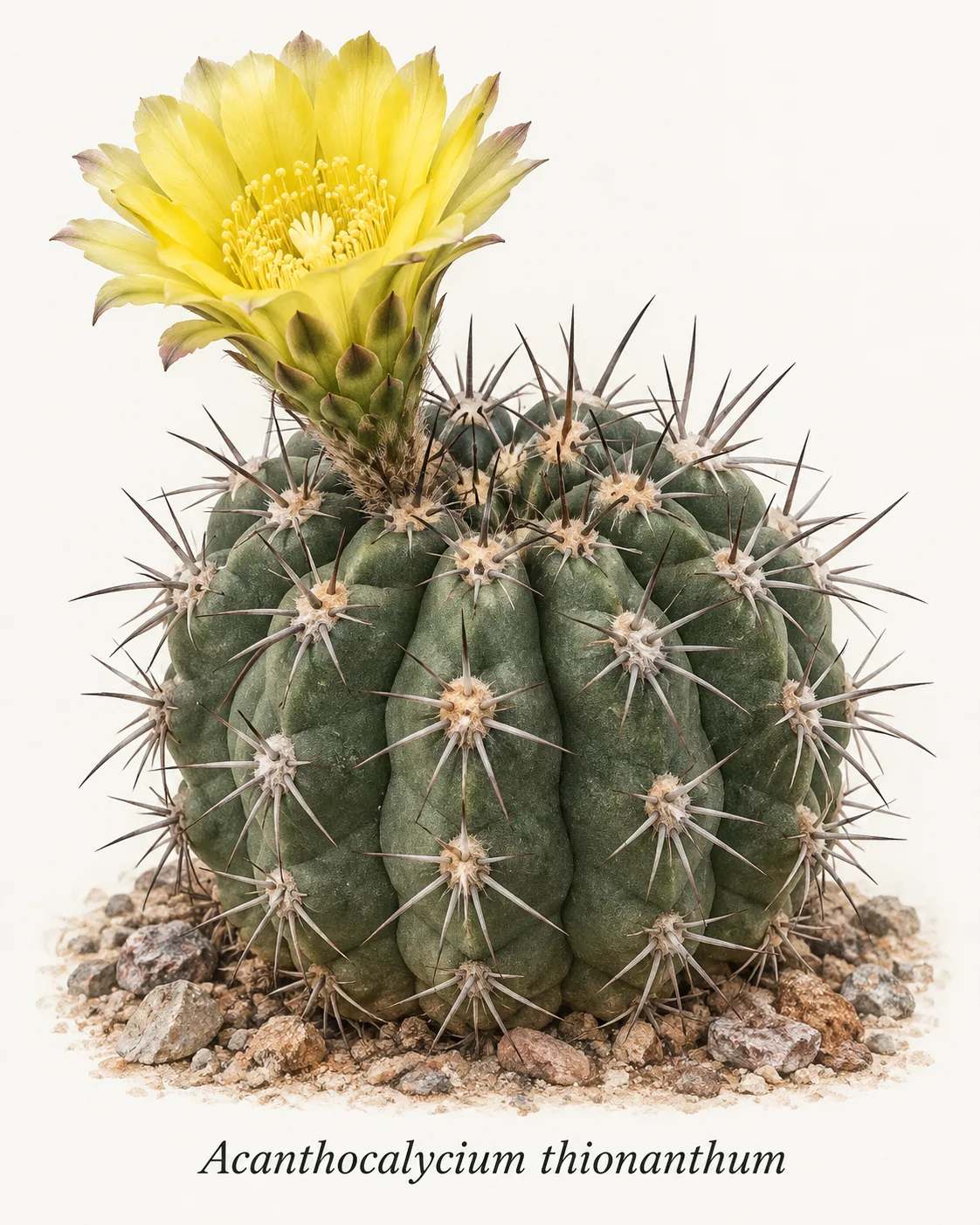
Acanthocalycium thionanthum. Stem with a yellow flower
Illustrative depiction of Acanthocalycium thionanthum from the supplied collection.
AI-generated illustration supplied by the site author.
Enlarge plate ↗Stem, roots and flowers
The studied plants had solitary stems ranging from globose to short cylindrical. At the end of drought, their bodies were shrunken and spines from neighbouring areoles interlocked. Fibrous roots spread mainly sideways through surface soil, mostly at depths of 2–6 cm. This brings much of the root system into the layer wetted by a brief shower. Flower buds formed in a ring around the stem apex. [Eggli and Giorgetta 2017]
Flowers were usually sulphur yellow, less often pale yellow and occasionally whitish or pinkish. Their colour remained stable during opening and closure. In sunny conditions, flowers opened at about 10 in the morning and began closing around 14. An individual flower could persist for three days, but closure occurred sooner after successful pollination. [Eggli and Giorgetta 2017]
Sites in the Valles Calchaquíes
Eggli and Giorgetta studied two sites near Angastaco in Salta Province. Cerro Negro lies at 1980 m and Cerro Bayo at 1925 m. Plants occupied relatively level sandy ground as well as rocky-sandy places. They grew both in exposed areas and beneath shrubs. The co-occurring Parodia microsperma more often occupied rocky microsites, which limited mixing between the two species. [Eggli and Giorgetta 2017]
From bud to fruit
Before the first rain, buds reached a similar developmental stage and could remain there for several weeks. Growth resumed after rainfall, with the Acanthocalycium flowering flush beginning around the eighth or ninth day. In years with average rainfall patterns, approximately 90% of present buds opened synchronously. This describes the studied populations at the beginning of the season. Later, plants produced additional flowers on a more scattered schedule. [Eggli and Giorgetta 2017]
Fruits ripened in approximately four weeks. They split from base to apex, exposing juicy pulp. Ants were seen consuming pulp and carrying seeds away. Flower removal by leaf-cutting ants was also recorded. Floral fate therefore depended both on visits potentially transferring pollen and on animals removing floral tissue. [Eggli and Giorgetta 2017]
Insects visiting the flowers
At the sites near Angastaco, flowers were visited by local bees, introduced honeybees, flies, butterflies and beetles. Some visitors also used Parodia microsperma flowers. Honeybees could locally displace solitary bees, while males of one observed bee defended occupied flowers. These records document behaviour affecting the sequence of visits. The researchers emphasized the need for further measurements to establish each insect’s contribution to pollen transfer and seed production. [Eggli and Giorgetta 2017]
Species circumscription
POWO recognizes subspecies thionanthum, ferrarii and glaucum. Echinocactus thionanthus and Echinopsis thionantha are synonyms of the species name. Observations from Angastaco do not automatically describe every population of all subspecies. In Schlumpberger and Renner’s cytological study, Acanthocalycium thionanthum material labelled ES9 had 2n = 22, documenting a diploid chromosome complement in that sample. [2-WWW] [Schlumpberger and Renner 2012]
Related articles
Materials from the author's archive
The species also appears in Konrad Szychowski's private material archive. [Kaktusy i Inne 2005a]
Synonyms and names in the literature
Echinocactus thionanthus · Echinopsis thionantha [2-WWW]