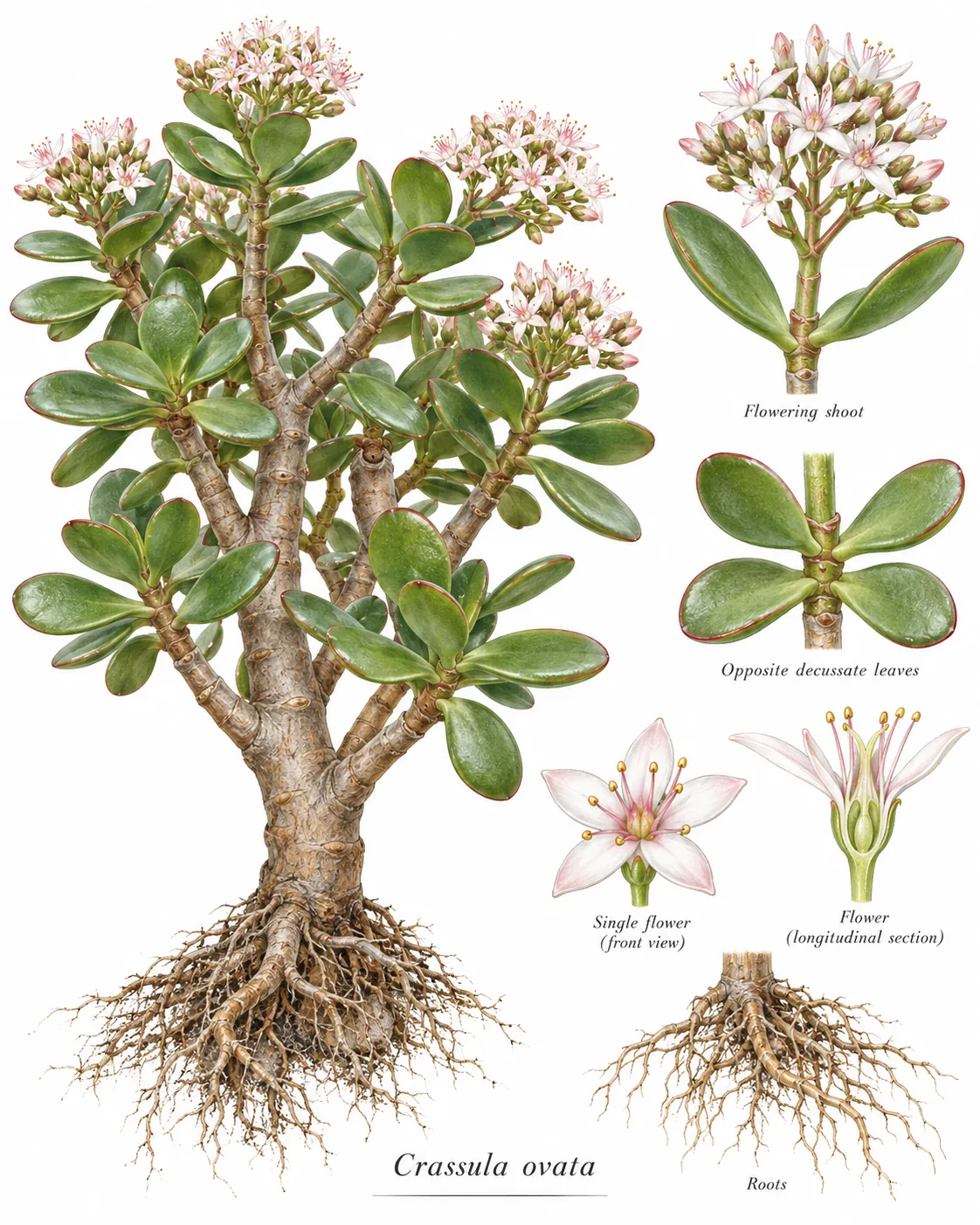
Crassula ovata. Illustrative depiction
Illustrative depiction supplied with the label Crassula ovata.
AI-generated illustration supplied by the website author. The name follows the label on the supplied image.
Enlarge plate ↗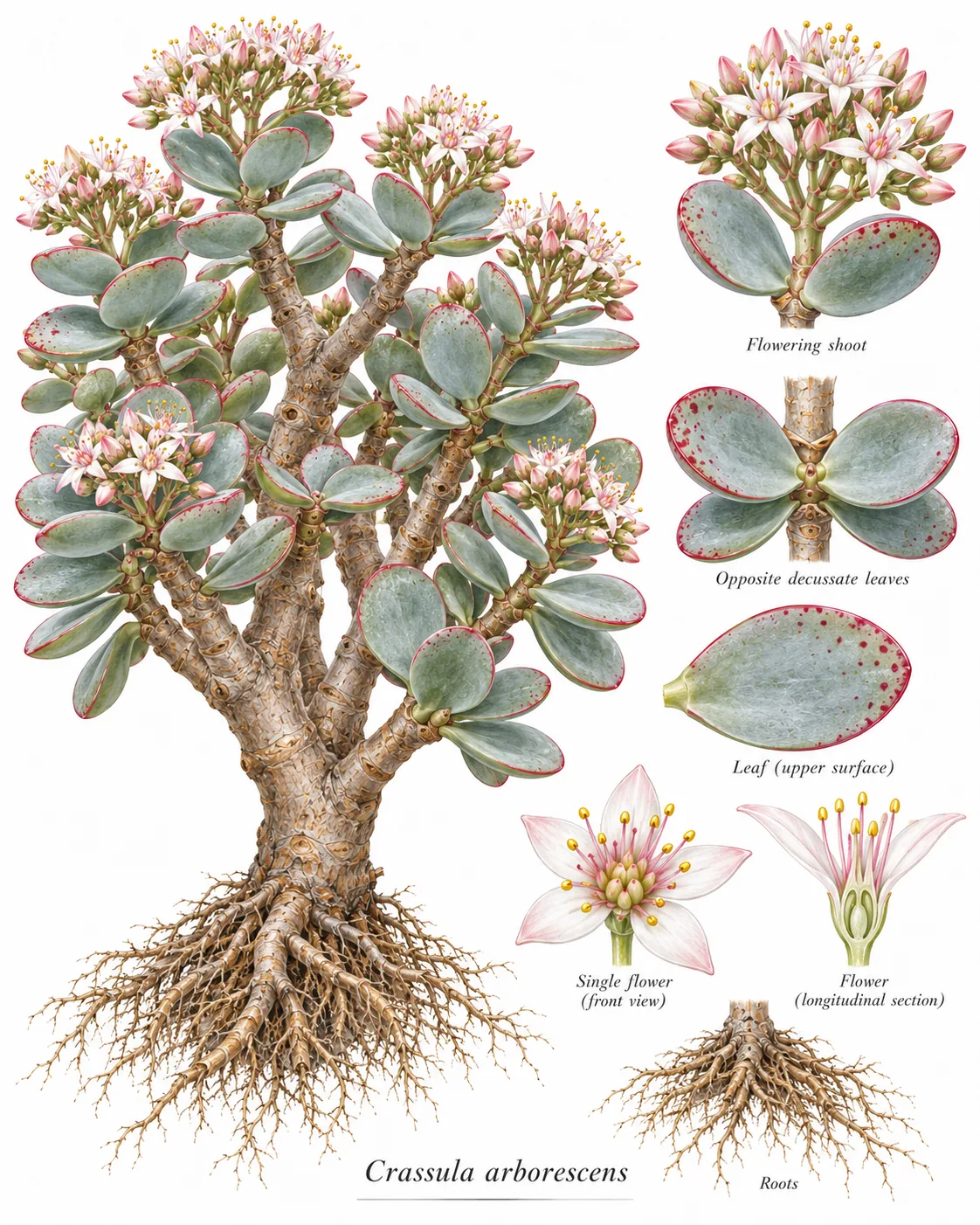
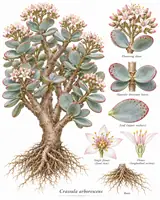
Crassula arborescens. Illustrative depiction
Illustrative depiction supplied with the label Crassula arborescens.
AI-generated illustration supplied by the website author. The name follows the label on the supplied image.
Enlarge plate ↗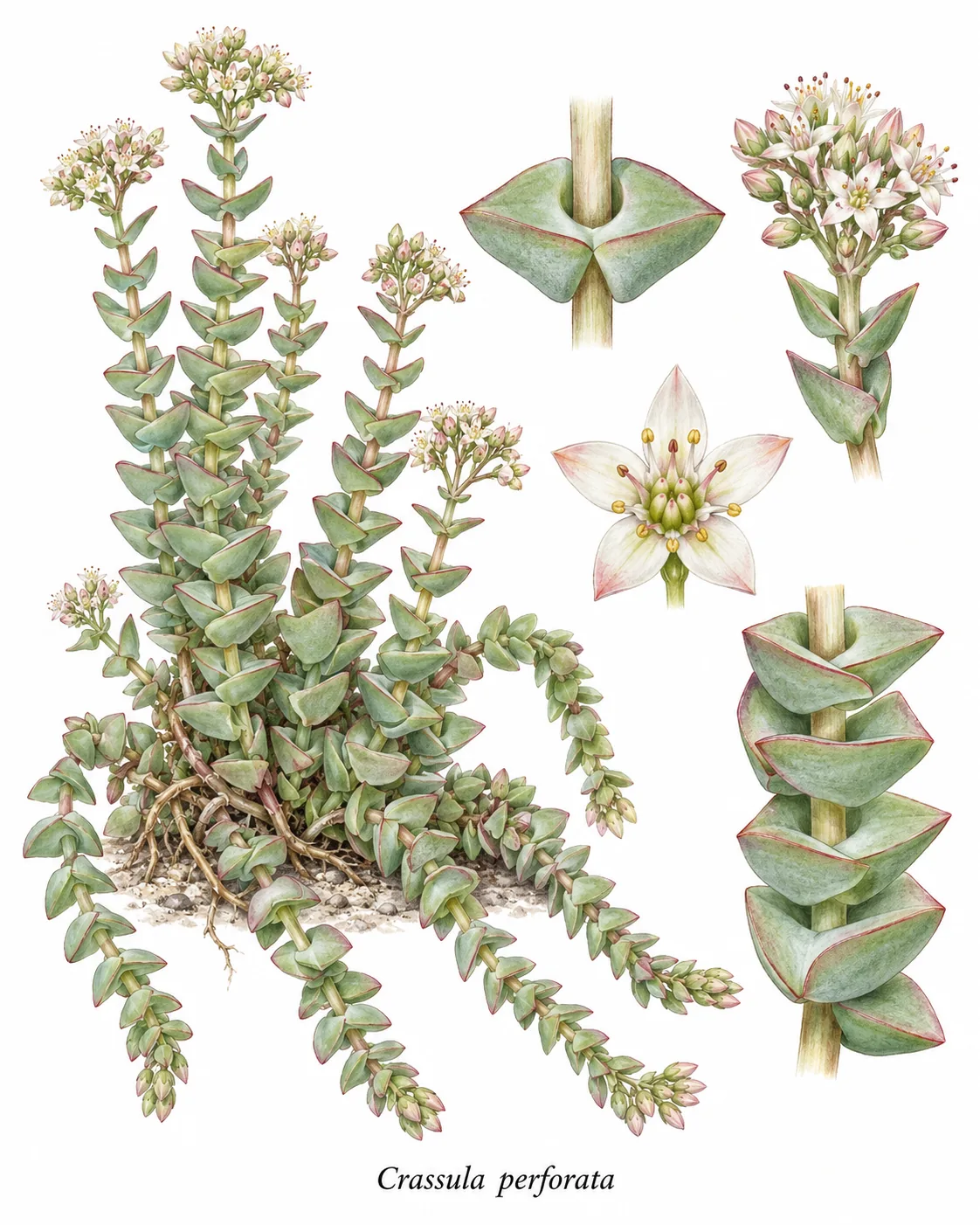
Crassula perforata. Illustrative depiction
Illustrative depiction supplied with the label Crassula perforata.
AI-generated illustration supplied by the website author. The name follows the label on the supplied image.
Enlarge plate ↗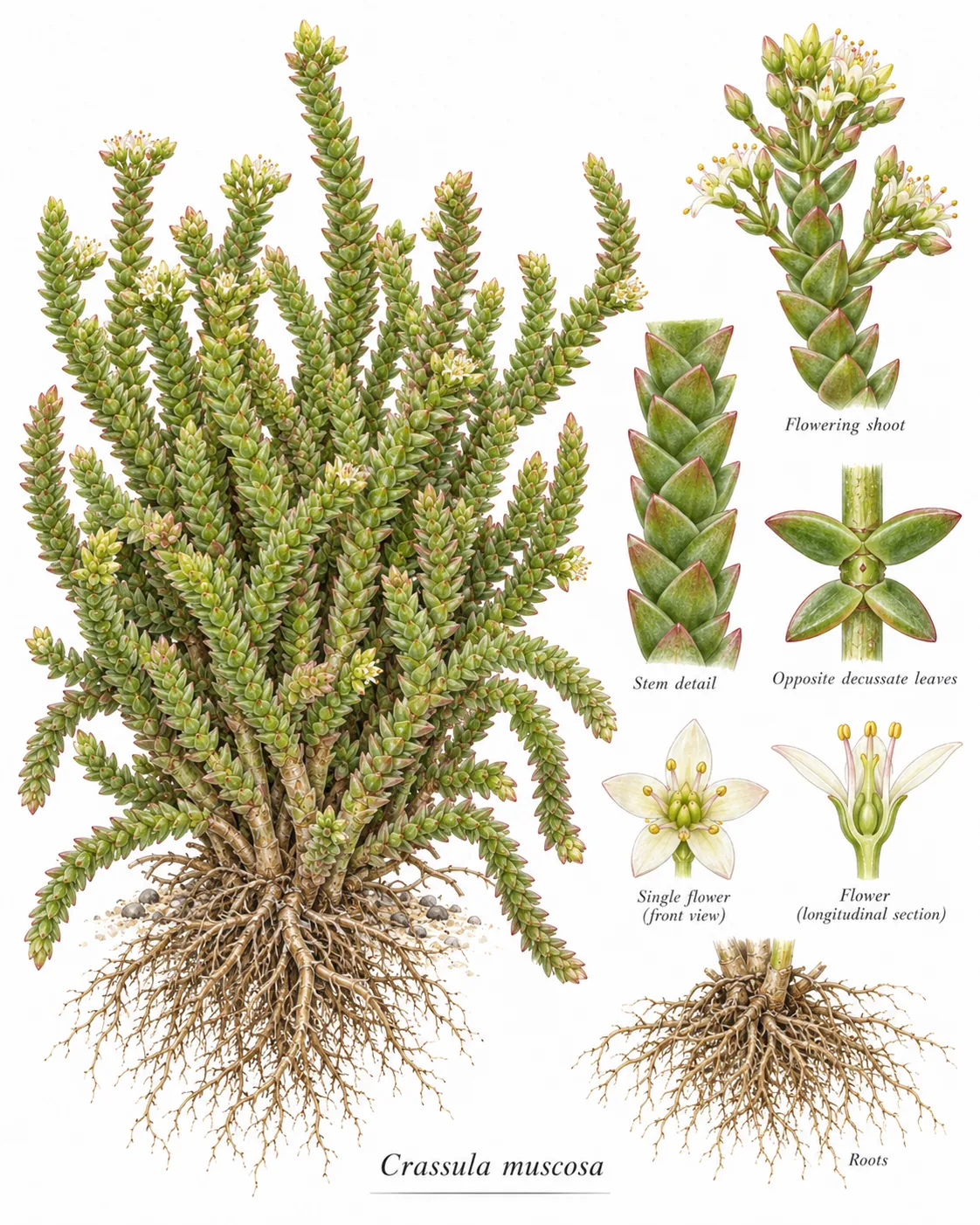
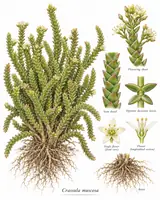
Crassula muscosa. Illustrative depiction
Illustrative depiction supplied with the label Crassula muscosa.
AI-generated illustration supplied by the website author. The name follows the label on the supplied image.
Enlarge plate ↗
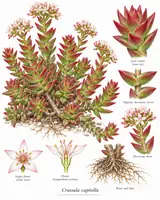
Crassula capitella. Illustrative depiction
Illustrative depiction supplied with the label Crassula capitella.
AI-generated illustration supplied by the website author. The name follows the label on the supplied image.
Enlarge plate ↗Scope of the genus
POWO lists 220 accepted species in the genus as consulted on 17 October 2026. Its combined native distribution is cosmopolitan. Crassula ovata, Crassula arborescens, Crassula perforata, Crassula muscosa, Crassula capitella and Crassula tetragona are separate accepted species. [2-WWW]
Different ways of storing water
A comparison of Crassula helmsii, Crassula multicava, Crassula ovata and Crassula socialis revealed shared features and clear differences. All examined leaves had a single-layered epidermis and stomata on both surfaces. The plants differed in cuticle thickness, hydathode distribution and stored water. Crassula ovata held most water per unit leaf area, whereas Crassula socialis had the highest mean when storage was related to organic matter. [Jones 2011]
Scope of physiological information
Succulence describes organ structure and water storage. CAM describes daily carbon fixation, with organic acids accumulating at night and being used in the light. Contributions of individual phases depend on species, organ and conditions. Identification of a particular mechanism requires physiological data, whereas Jones’s four-species comparison primarily provides anatomical information. [Jones 2011] [Males and Griffiths 2017]