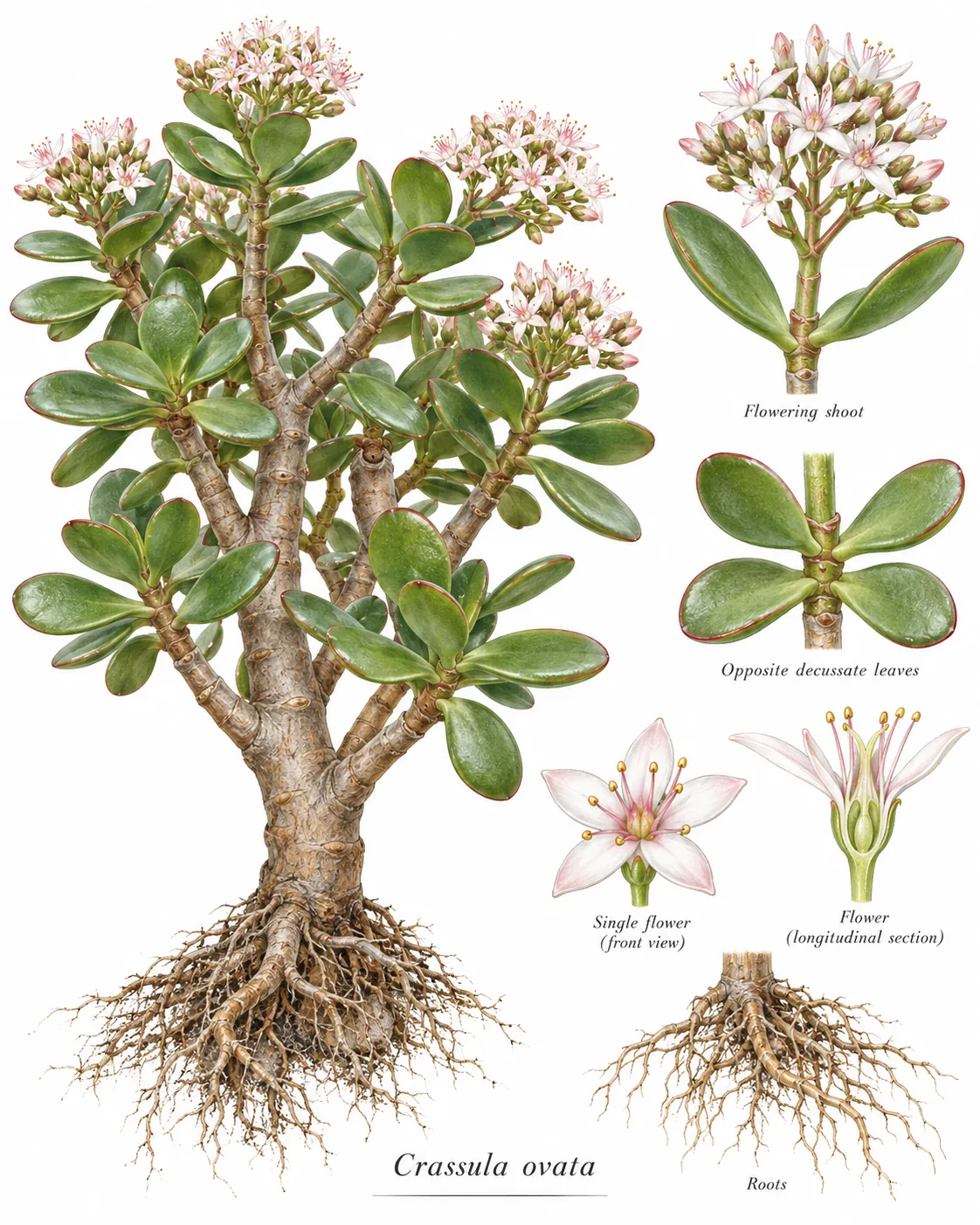
Crassula ovata. Illustrative depiction
Illustrative depiction supplied with the label Crassula ovata.
AI-generated illustration supplied by the website author. The name follows the label on the supplied image.
Enlarge plate ↗Name and natural range
POWO accepts Crassula ovata (Mill.) Druce. Crassula argentea and Crassula portulacea are synonyms. The native range extends from southeastern Mozambique to the southeastern Cape region. In South Africa it occurs in valley thicket and on rocky slopes. [2-WWW] [18-WWW]
Leaves and flowering
Leaves occur in opposite pairs, with successive pairs rotated relative to one another. Blades are oval or elliptic and often develop red margins. SANBI describes fragrant pale-pink flower clusters during the cool season in the South African habitat. It also reports propagation from shoot fragments and individual leaves, together with CAM. [18-WWW]
Anatomy of water storage
In Jones’s greenhouse comparison, this species had the highest leaf water content per unit area among the four crassulas examined. Its epidermis was single-layered, with stomata on both leaf surfaces. Hydathodes, larger pores associated with vascular endings, also occurred on both surfaces. Their density on the upper leaf surface was highest within the sampled group. [Jones 2011]
The examined stems were woody and covered by periderm, a secondary protective tissue. Cells containing chloroplasts occurred beneath it. These findings describe the experimental material’s structure. Stem CO₂ exchange and actual water uptake through hydathodes were not measured in this study. Leaf water content and the presence of a particular tissue therefore provide different evidence from measurements of its activity. [Jones 2011]
Growing in containers
RHS recommends a bright position under cover and freely draining succulent compost. During growth, watering maintains slight moisture, while winter watering is greatly reduced. Stem and leaf cuttings can be prepared in spring. The RHS H2 rating indicates a need for protection from freezing. [1-WWW]
Pets
ASPCA lists this species under the synonym Crassula argentea as toxic to dogs, cats and horses. Reported signs include vomiting, depression and incoordination. Suspected ingestion calls for contact with a veterinarian. [28-WWW]
Related articles
Synonyms and names in the literature
Crassula argentea · Crassula portulacea · Cotyledon ovata · Toelkenia ovata [2-WWW]