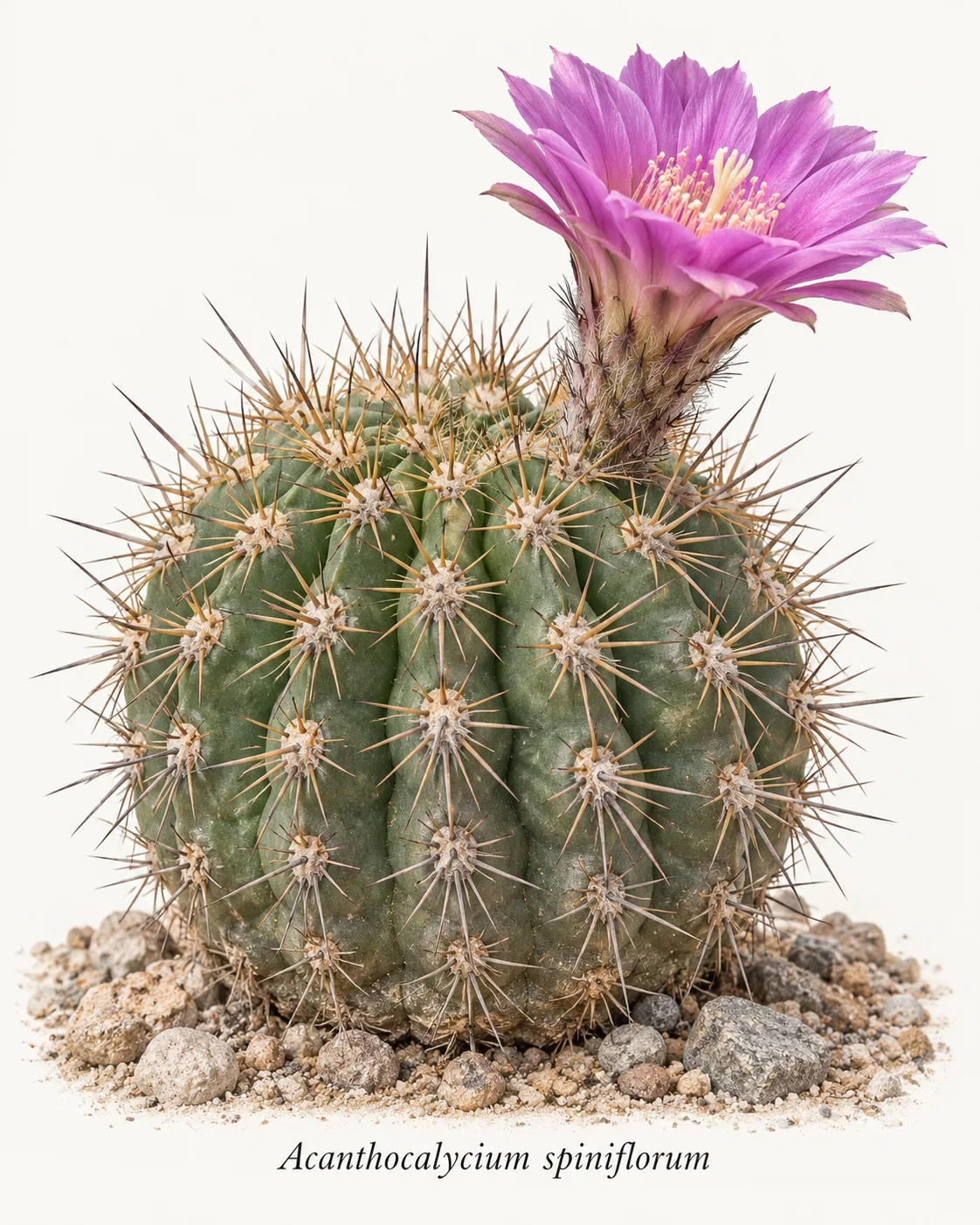
Acanthocalycium spiniflorum. Stem with a pink flower
Illustrative depiction of Acanthocalycium spiniflorum from the supplied collection.
AI-generated illustration supplied by the site author.
Enlarge plate ↗Growth form and variation
The RHS profile describes a dull green stem up to 15 cm in diameter, with numerous ribs and clusters of strong spines. Trumpet-shaped flowers appear in summer. Floral colour and the degree of stem elongation vary with the material examined. POWO includes the former Acanthocalycium violaceum, Acanthocalycium klimpelianum and Acanthocalycium peitscherianum within Acanthocalycium spiniflorum. Accounts under these names may therefore describe different portions of the variation within one broadly circumscribed species. [1-WWW] [2-WWW]
The Córdoba and San Luis mountains
Chiapella and Demaio included the species in their checklist of plants endemic to the Sierras de Córdoba and San Luis. Their regional compilation records it at 1000–1500 m. This area is an isolated mountain system in central Argentina, with vegetation changing along the elevation gradient. The regional treatment links the species with the local mountain flora and allows comparisons with other cacti of the same ranges. [Chiapella and Demaio 2015]
Chromosomes and relationships
In Schlumpberger and Renner’s study, Acanthocalycium spiniflorum was represented by samples from Córdoba. The chloroplast DNA analysis placed it in a lineage containing other Acanthocalycium and plants then called Echinopsis leucantha. This placement indicates shared evolutionary history despite conspicuous differences in flower length, colour and opening time among members of the group. [Schlumpberger and Renner 2012]
The authors reported 2n = 22 for the examined material, corresponding to a diploid chromosome complement. Their table gives three counts for material labelled BOS 401. This is a number of cytological observations documenting a particular sample. Separate earlier literature records under Acanthocalycium violaceum also reported 22 chromosomes. The compilation therefore connects historical identifications with the present species concept. [Schlumpberger and Renner 2012]
Cultivation under glass
RHS recommends a bright sunny position under glass and peat-free loam-based compost with additional grit. Watering is moderate during growth and restricted during dormancy. A balanced liquid fertilizer is applied two or three times during the growing season. The RHS propagation methods are seed and offsets where these develop. [1-WWW]
The profile’s H2 rating calls for protection from freezing. In Polish cultivation, this means winter accommodation with suitable light. The rating is horticultural guidance for the described material. Prolonged rain, root-zone temperature and the plant’s growth activity provide the context determining how much water remains in a pot. [1-WWW]
Related articles
Materials from the author's archive
The species also appears in Konrad Szychowski's private material archive. [Kaktologia 2009b] [Neciu n.d.] [Kaktusy i Inne 2005a]
Synonyms and names in the literature
Acanthocalycium klimpelianum · Acanthocalycium klimpelianum var. macranthum · Acanthocalycium peitscherianum · Acanthocalycium violaceum · Echinocactus spiniflorus · Echinopsis klimpeliana · Echinopsis peitscherana · Echinopsis spiniflora · Echinopsis violacea · Lobivia klimpeliana · Lobivia spiniflora · Lobivia spiniflora var. klimpeliana · Lobivia spiniflora var. macrantha · Lobivia spiniflora var. peitscheriana · Lobivia spiniflora var. violacea [2-WWW]