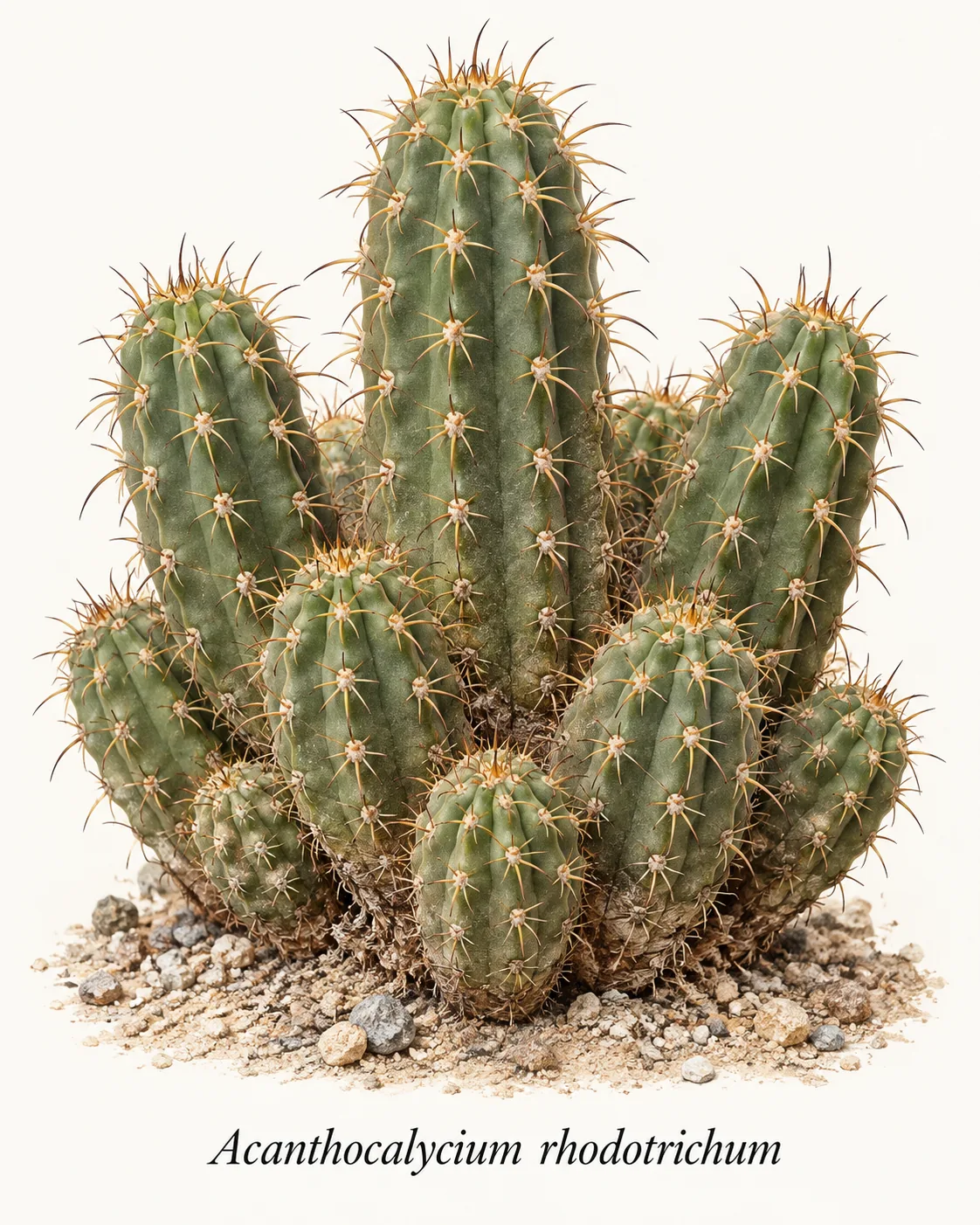
Acanthocalycium rhodotrichum. A group of elongated stems
Illustrative depiction of Acanthocalycium rhodotrichum from the supplied collection.
AI-generated illustration supplied by the site author.
Enlarge plate ↗Flower structure
In the population near Porto Murtinho, flowers averaged 17.5 cm long and the expanded perianth measured approximately 7.8 cm across. Measurements involved 15 flowers, one per plant. A narrow elongated tube accounts for much of the flower’s length. White tepals spread radially, and numerous stamens surround the central pistil. Nectar accumulates in the lower part of the tube, so its position affects how visitors can reach it. [Ferreira et al. 2018]
Flowering in the Brazilian Chaco
Ferreira and colleagues observed plants in two Chaco vegetation remnants near Porto Murtinho, Mato Grosso do Sul. Phenology was recorded monthly from December 2014 to November 2015 on 15 marked adults of this species. Flowers were present in nine months of the study year, with reproductive activity concentrated in the wet season. These dates describe the seasonal conditions at the particular Southern Hemisphere site. [Ferreira et al. 2018]
Opening began at approximately 20 h, and the flowers were fully expanded about an hour later. They remained functional until late morning and wilted at around 11 h. The total period of availability lasted approximately 15 hours. This schedule spans both nighttime and the morning activity of bees. A mild sweet scent and nectar complemented the signals associated with floral colour and architecture. [Ferreira et al. 2018]
Self-compatibility and pollen transfer
No fruit developed among 20 isolated flowers receiving no manual pollen transfer. Hand self-pollination produced fruit in 5 of 18 flowers, whereas pollen from another plant produced 6 fruits from 10 flowers. Self pollen could therefore support reproduction in the studied material, provided that it reached the stigma. Self-compatibility and the ability to self-pollinate spontaneously describe different stages of this process. [Ferreira et al. 2018]
Bees were observed at the flowers, and pollen of the species was found on the proboscises of captured hawkmoths. Pollen carriage establishes contact with flowers, while a contribution to pollination also depends on delivery to a suitable stigma. The authors considered pollen flow between three co-occurring cactus species. Their fluorescent-marker trial did not detect such transfer within the observation design used. [Ferreira et al. 2018]
Fruit and the name used in studies
The fruit is red and hairy and opens through longitudinal splits. Its pale pulp contains numerous black seeds. The researchers evaluated seed viability with tetrazolium, an indicator of activity in living tissues. The paper’s name Echinopsis rhodotricha corresponds to Acanthocalycium rhodotrichum in POWO, with the studied material documented by herbarium voucher CGMS 53698. [Ferreira et al. 2018] [2-WWW]
Range and comparative documentation
POWO records a range from Bolivia to west-central Brazil, northeastern Argentina and Uruguay. The Chaco experiments involved two remnants of natural vegetation on Retiro Conceição and Anahi farms, approximately 3 km apart. The same project examined Harrisia balansae and Praecereus saxicola. All three species had large nocturnal flowers and partly shared visitors. Comparing their reproductive systems revealed different pollination possibilities despite the broad similarity of their flowers. [Ferreira et al. 2018] [2-WWW]
Related articles
Synonyms and names in the literature
Curvoacanthocactus rhodotrichus · Echinopsis rhodotricha [2-WWW]