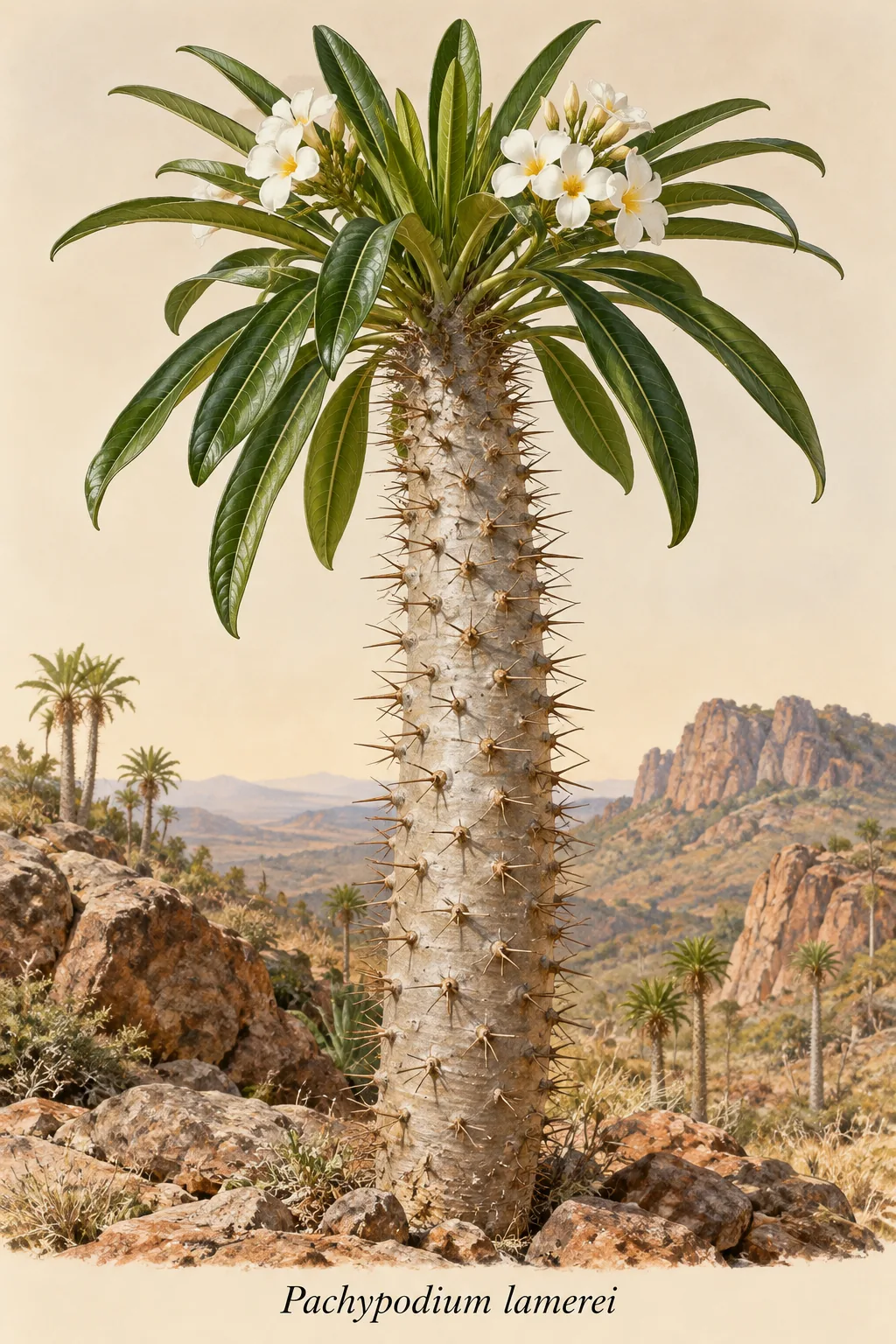
Pachypodium lamerei. Stem and leaf crown
Habit of Pachypodium lamerei with a crown of leaves and flowers at the shoot apex.
Illustrative depiction supplied by the site author.
Enlarge plate ↗Trunk and armature
Three strong spines usually occur at the leaf base. Two are lateral and the third occupies a central position. Lüthy also described stem sections and populations lacking the central spine. Identification consequently relies on a combination of characters. The trunk thickens with growth, and the crown may vary considerably in proportion to trunk length. [Lüthy 2004]
Identification and names
The similar Pachypodium geayi has narrower leaves and distinctive pubescence on young stems and spines. In Pachypodium lamerei, the stamens remain inside the corolla tube. Its hanging fruits have thick, backward-curving follicles with rounded tips. The distinct Pachypodium menabeum has upright, spindle-shaped fruits. These reproductive characters are used in Lüthy’s identification key. [Lüthy 2004]
POWO accepts Pachypodium lamerei Drake and includes Pachypodium ramosum and Pachypodium champenoisianum among its synonyms. Pachypodium menabeum retains species rank. [2-WWW] [Lüthy 2004]
Range and variation
Lüthy records the species from sea level to approximately 800 m elevation. Its broad range includes variation in trunk and leaf shape. The revision emphasizes the need to separate Pachypodium menabeum, which had been included in northern records on earlier distribution maps. This correction also clarifies the interpretation of variation in Pachypodium lamerei. [Lüthy 2004]
Photosynthesis in leaves and stems
In the experiments of Eder and colleagues, CO₂ exchange by the whole plant, detached leaves and the leafless stem followed a C3 pattern. Carbon isotope measurements supported this interpretation. The δ¹³C values were −27.41‰ for the stem and −26.33‰ for the leaves. These measurements refer to the experimental material described in the 1981 paper. [Eder et al. 1981]
Cultivation and propagation
RHS recommends full light under glass and cactus compost. From late spring to early autumn in European cultivation, watering is moderate and a low-nitrogen liquid feed is applied every 4–5 weeks. The plant is kept dry at other times. H1A denotes year-round cultivation under glass above 15°C. Seeds are sown at 19–24°C. RHS also lists stem-tip cuttings taken in late spring. [1-WWW]
Lüthy records the use of Pachypodium lamerei as a rootstock for other members of the genus, including Pachypodium brevicaule and Pachypodium namaquanum. This documented horticultural practice is associated with its rapid growth. The rootstock use concerns a method for propagating and maintaining plants in cultivation. [Lüthy 2004]
Related articles
Materials from the author's archive
The species also appears in Konrad Szychowski's private material archive. [Neciu 2005] [Kaktusy i Inne 2006a]
Synonyms and names in the literature
Pachypodium ramosum · Pachypodium champenoisianum · Pachypodium lamerei var. ramosum · Pachypodium rutenbergianum f. lamerei [2-WWW]