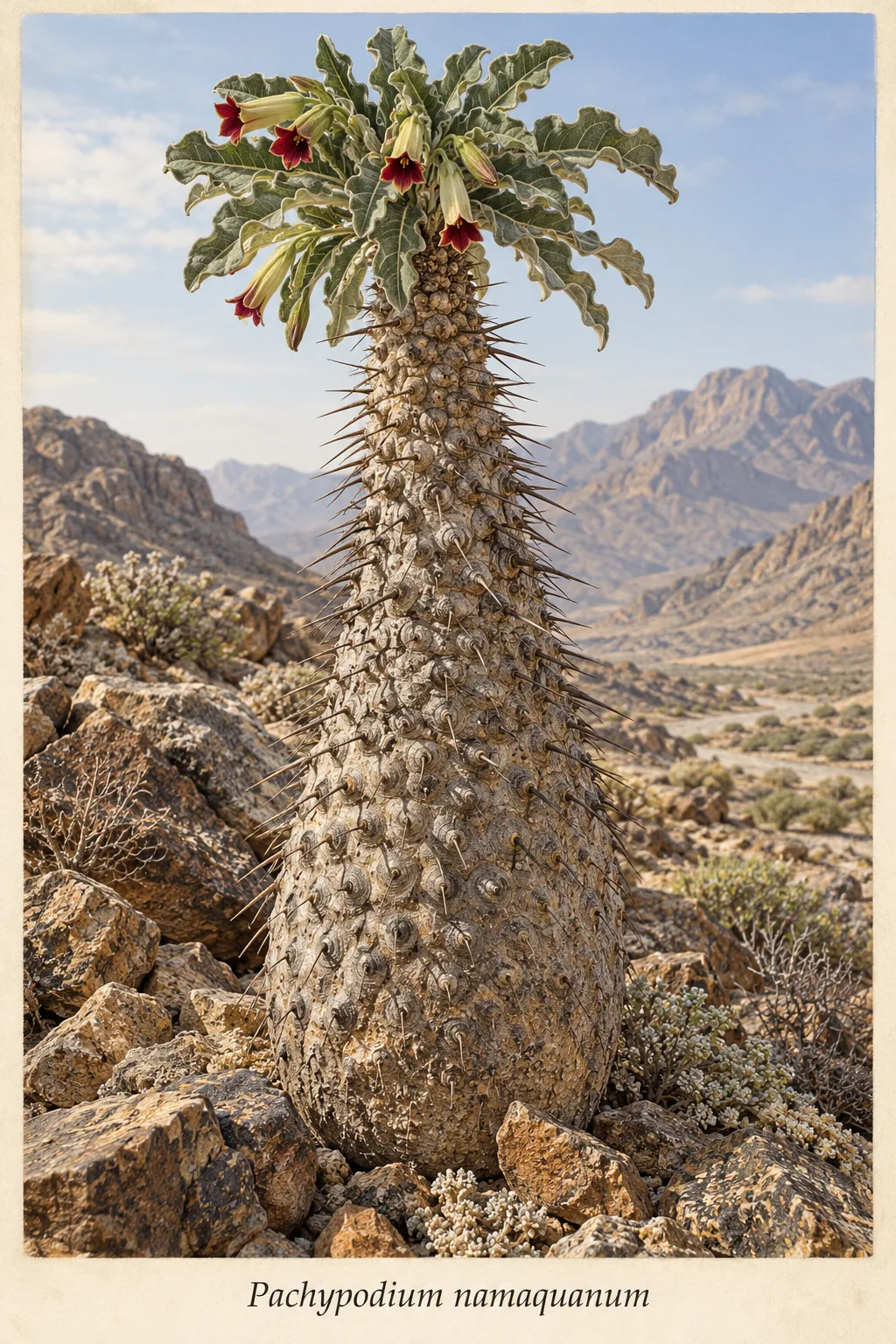
Pachypodium namaquanum. Spiny stem
Pachypodium namaquanum with a markedly thickened stem and leaves clustered near the apex.
Illustrative depiction supplied by the site author.
Enlarge plate ↗Trunk, leaves and flowers
The flora account gives a usual height of 1.5–2.5 m. The trunk is mostly unbranched and tapers upwards. Two long spines at the leaf base accompany shorter structures. The grey-green leaves are velvety and have wavy margins. The tubular corolla measures 2.5–5 cm, with yellow-green colouring outside and deep red within. [Codd 1963]
The fruit comprises two follicles. On opening it releases numerous seeds bearing a tuft of whitish hairs. [Codd 1963]
Leaves in the South African winter
Rundel and colleagues describe leaves emerging in April and falling in October in the Richtersveld. These months mark southern hemisphere autumn and spring. Activity therefore spans the cooler season, while the plant rests through the hot, extremely dry summer. [Rundel et al. 1995]
Apical inclination and light capture
The trunk apex curves northwards, orienting the leaves towards the winter sun. In the studied populations, leaf surfaces had a mean inclination of 55° from horizontal. The authors calculated nearly twice the midwinter radiation absorption of a horizontal orientation. [Rundel et al. 1995]
Phylogenetic position
The 2013 ITS and trnL-F analysis grouped Pachypodium namaquanum with Pachypodium bispinosum and Pachypodium succulentum. The latter two formed a closer pair, sister to Pachypodium namaquanum. This result connects a tall, largely unbranched trunk with low-growing shrubby relatives. Its resemblance in outline to Malagasy tree-form Pachypodium is a separate character set from the relationships reconstructed with these markers. [Burge et al. 2013]
Cultivation and seed propagation
SANBI recommends a bright, ventilated position and reduced moisture during dormancy. Fresh seed is used after removing the tuft of hairs. Its method combines river sand with sifted compost or bark in a 1 to 1 ratio. Excess water after germination encourages rot. SANBI’s October-to-March summer dormancy refers to South African cultivation. In Poland, watering follows actual leaf development and overwintering conditions. [18-WWW]
Related articles
Materials from the author's archive
The species also appears in Konrad Szychowski's private material archive. [Neciu 2005]
Synonyms and names in the literature
Adenium namaquanum [2-WWW]