Stones that changed growing conditions
Ancient agave fields contained terraces, rows of stones and rock piles. These were placed on slopes and surfaces receiving runoff. Such structures slowed water movement, increased rainfall infiltration and reduced evaporation. Fine soil particles and nutrients also accumulated within them. Modified conditions around the roots supported cultivation where agricultural productivity depended on brief rainfall events. This technology expanded after 1000 CE as the regional population increased. [Hodgson et al. 2023]
Archaeologists recognized cultivation through the association of stone structures, agave-processing tools, roasting pits and charred plant remains. Macroscopic remains often identified agave, while species identification required additional evidence. Modern botanical surveys added living plants found around ancient settlements and fields. Bringing these two forms of evidence together provided a basis for reconstructing part of the cultivation history. [Hodgson et al. 2023]
Six surviving lineages
Hodgson, Rosenthal and Salywon describe Agave murpheyi, Agave delamateri, Agave phillipsiana, Agave sanpedroensis, Agave verdensis and Agave yavapaiensis as six ancient domesticated agave species associated with Arizona’s landscape. Their present distributions connect with areas occupied by Hohokam, Sinagua, Ancestral Pueblo and other communities. Some species occur across several cultural areas, which the authors relate to the movement and exchange of planting material. This is an interpretation combining plant distributions with archaeological evidence. [Hodgson et al. 2023]
Agave murpheyi produces numerous small rosettes on an undamaged inflorescence. These bulbils persisted for more than a year, including through drought, and could be transported and planted. The other described species rely mainly on offsets. Agave verdensis and Agave yavapaiensis occasionally produce a small number of fruits and viable seeds, and seed reproduction is also rare in Agave murpheyi. Propagation from offsets allowed favourable combinations of traits to persist without being reshuffled through sexual reproduction in every generation. [Hodgson et al. 2023]
Trait selection and the rhythm of harvesting
The review identifies a combination of traits probably maintained by ancient farmers. These include easy vegetative propagation, relatively rapid maturation, leaves convenient to process and desirable taste. Repeatedly planting selected offsets could maintain these traits across generations. Past selection is reconstructed indirectly from present plant structure and biology together with cultural context. The origins of individual lineages from wild ancestors require further investigation. [Hodgson et al. 2023]
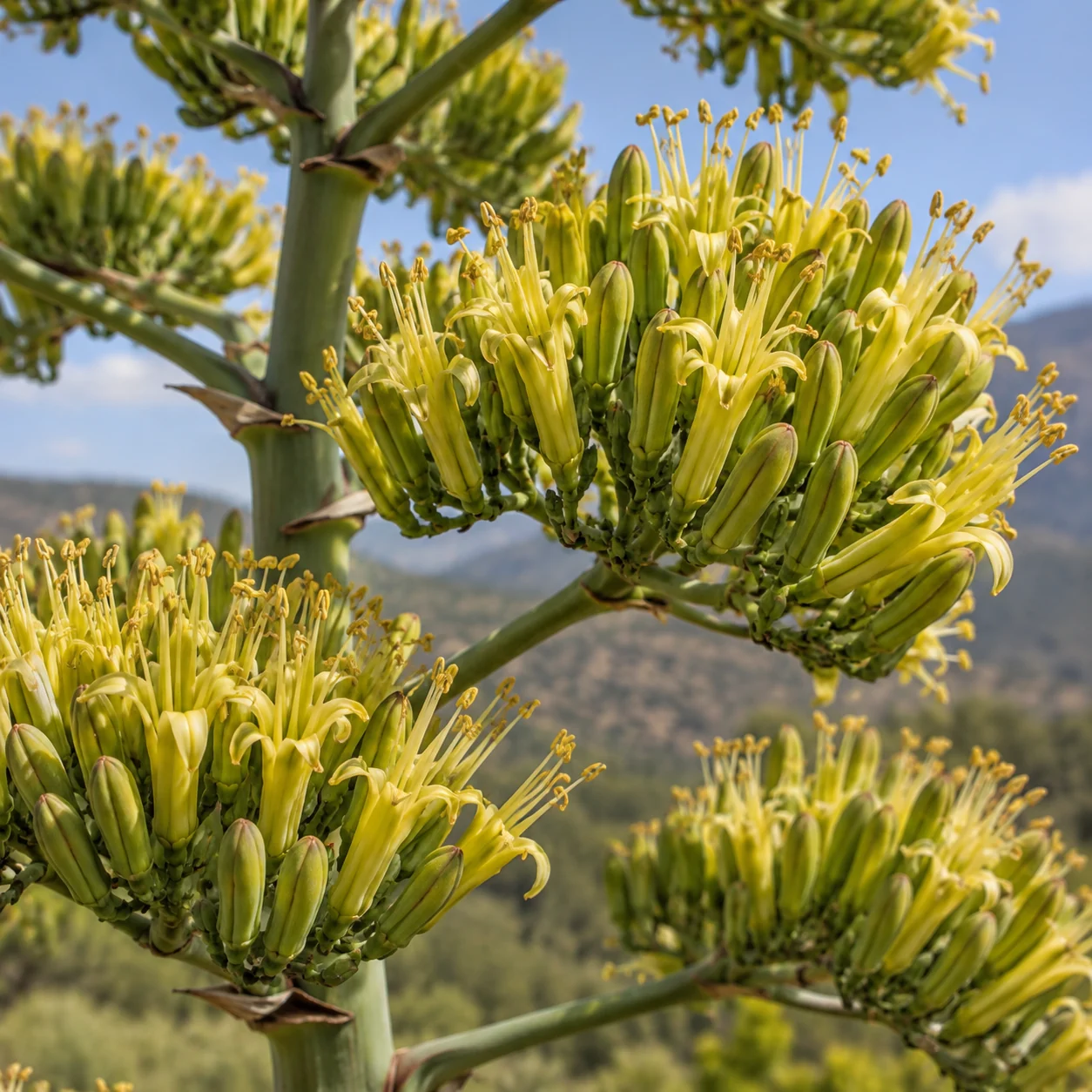
The development of different species could spread harvesting through time. Similar flowering times among plants of one lineage facilitated coordinated harvest and processing, while growing several lineages extended the season of crop availability. In Agave murpheyi, winter initiation of the flowering stalk provided food when other fresh plant resources were scarce. The review also reports maturation within 7–10 years with supplemental watering. This observation describes particular cultivation and resource conditions. [Hodgson et al. 2023]
Persistence through successive rosettes
An agave rosette connected with other offsets can be regarded as part of a larger clone. When one rosette flowers and dies, others can continue growing. The genetic lineage persists while individual rosettes are replaced. This mechanism explains how ancient cultivated agaves survived for centuries. A present-day cluster is therefore a living record of continuous vegetative propagation, made up of younger units descended from earlier plants. [Hodgson et al. 2023] [Eguiarte et al. 2021]
The genetic comparisons discussed in the review suggest that surviving Agave murpheyi and Agave delamateri are less diverse than many wild agaves, while retaining more variation than some modern monocultures. The authors relate this pattern to the cultivation of several variants and the exchange of planting material. Later settlement changes and the loss of field management reduced both plant abundance and the diversity retained. This is a complex history of the use of several species, with local pathways of development and persistence. [Hodgson et al. 2023]
Plants together with their setting
Conserving these agaves involves the plants, surviving features of ancient fields and the knowledge of communities connected with their use. Stone structures help explain crop-growing conditions, while the positions of living clones reveal links among cultivation, settlement and exchange. The review emphasizes collaboration among botanists, archaeologists and Indigenous communities. Further genetic research and comparison of living plants with archaeological remains may identify the origins and uses of individual lineages more precisely. [Hodgson et al. 2023]
Pre-contact Agave domesticates – living legacy plants in Arizona’s landscape
Hodgson W. C., Rosenthal E. J., Salywon A. M., Pre-contact Agave domesticates – living legacy plants in Arizona’s landscape, Annals of Botany, 2023, 132(4):835-853, doi: 10.1093/aob/mcad113
A review of six ancient domesticated agaves in Arizona combines botanical, genetic and archaeological evidence. It describes stone field structures, traits of selected lineages, reproduction, clonal persistence and cultural significance.
Evolutionary ecology of Agave: distribution patterns, phylogeny, and coevolution (an homage to Howard S. Gentry)
Eguiarte L. E., Jiménez B. O. A., Aguirre-Planter E., Scheinvar E., Gámez N., Gasca-Pineda J., Castellanos-Morales G., Moreno-Letelier A., Souza V., Evolutionary ecology of Agave: distribution patterns, phylogeny, and coevolution (an homage to Howard S. Gentry), American Journal of Botany, 2021, 108(2):216-235, doi: 10.1002/ajb2.1609
This review connects agave distribution and drought adaptations with phylogeny, pollination biology and population genetics. It discusses research history, clonal propagation, past and present uses, and conservation of agaves and their pollinators.