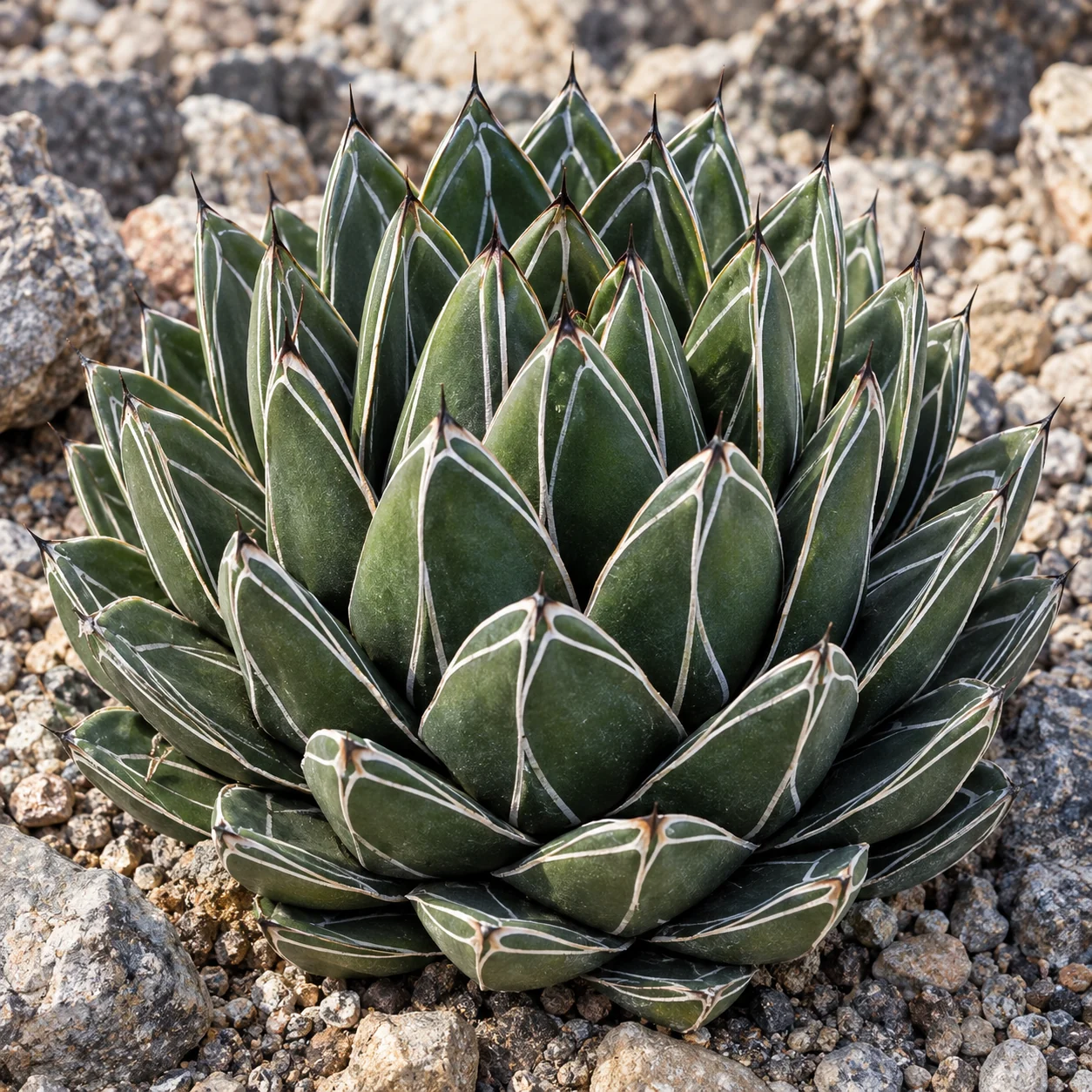
Agave victoriae-reginae. White leaf markings
Compact Agave victoriae-reginae rosette. White markings are visible on the leaf surfaces.
Illustrative image generated with AI and supplied by the website author.
Enlarge plate ↗Leaves and flowering
The leaves are thick, rigid and spine-tipped. White markings and horny leaf margins characterize the species complex in which this agave was formerly included. A narrow inflorescence carries pale flowers high above the rosette. [González-Elizondo et al. 2011] [1-WWW]
Species circumscription
A revision published in 2011 separated the former complex into Agave victoriae-reginae, Agave nickelsiae and Agave pintilla. Two subspecies were recognized within the first species. Plants of the World Online accepts Agave victoriae-reginae subsp. victoriae-reginae and Agave victoriae-reginae subsp. swobodae. Historical records and collection labels therefore require verification before their information is assigned to this card. [González-Elizondo et al. 2011] [2-WWW]
Position in studies of the genus
Agave victoriae-reginae was sampled in the phylogenetic study published in 2020. The authors compared chloroplast DNA regions with nuclear ITS. The latter provided more variable sites and resolved some lineages more clearly. The species fell outside the three most clearly distinguished younger groups, illustrating the limitations of a simple division by inflorescence appearance. This placement is the result of a particular analysis and depends on the markers and species sampled. [Jiménez-Barron et al. 2020]
Growing in containers
RHS recommends cactus growing medium, summer watering and almost dry overwintering under cover. Plants can spend summer outdoors. Offsets, when present, are removed in spring or autumn. These recommendations reflect the horticultural practice described by RHS. [1-WWW]