Lophophora williamsii

Lophophora williamsii
Name and range
The accepted name is Lophophora williamsii (Lem. ex J.F.Cels) J.M.Coult. (formerly, among others, Echinocactus williamsii, Anhalonium williamsii and Mammillaria williamsii). Current POWO treatment also includes the names L. lewinii, L. echinata and L. jourdaniana. It gives a natural range from southwestern and southern Texas to northeastern Mexico, extending towards Jalisco. [2-WWW] [2-WWW]
Flora of North America describes sites in Chihuahuan Desert scrub and Tamaulipan thornscrub, usually on or near limestone hills. The reported elevation range is 100–1500 m, exceptionally up to 1900 m. The aboveground part lies almost level with the soil surface. [Zimmerman and Parfitt 2003c]
In Texas, the species occupies two different regions. In the south, it occurs in Tamaulipan thornscrub, and in the west in Chihuahuan Desert vegetation. Both systems share a limestone substrate. In the study of six populations from 2019, western sites were higher, drier and cooler, especially at night. The climatic difference observed coincided with a difference in plant size, and the effects of individual factors were not experimentally separated. [Ermakova et al. 2021, p. 150, 154–158]
Body and flowering
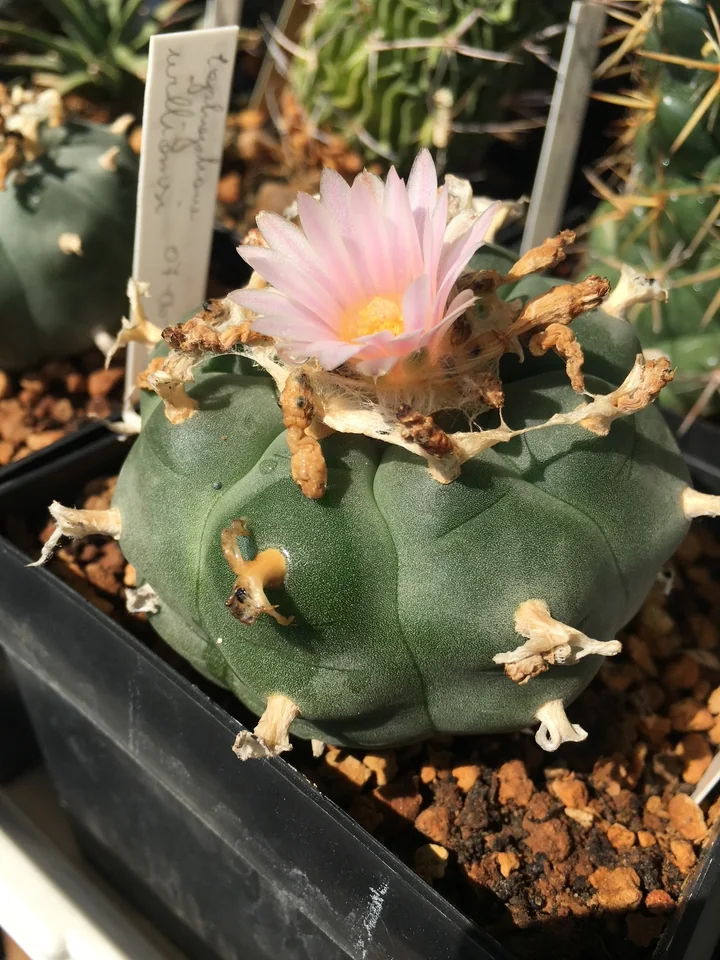
The stem is flattened or dome-shaped, with a deeply sunken apex and broad, gently rounded ribs. Plants remain solitary or produce branches. The epidermis is soft, and adult areoles have tufts of hairs. The fleshy root is broadly carrot-shaped, 6–12 cm long in the flora description. Slow growth accompanies the individual’s long lifespan. [Zimmerman and Parfitt 2003c]
Inner tepals have pale, whitish to greenish-pink margins and darker central stripes. In the area described by the flora, flowering occurs mainly in March–May, extending to September. Fruits may ripen rapidly only many months after flowering, even after about a year. [Zimmerman and Parfitt 2003c]
Fruits are indehiscent and only slightly juicy, drying and shrinking rapidly after ripening. The black seeds have convex seed-coat cells. In the genus description, fruits measure 11–25 × 4–5 mm and seeds 1–1,5 × 1–1,2 mm. These are ranges given for the genus in the Flora of North America treatment from 2003, which then included two species. [Zimmerman and Parfitt 2003c, genus and species description in FNA, pp. 241–243]
Underground stem and root
Terry and Mauseth’s histological study covered five plants of different sizes, including two young specimens and three adults. Most material came from southern Texas. The underground stem portion had vascular bundles in the primary cortex and a parenchymatous pith. The root lacked such cortical bundles, and its centre contained metaxylem elements, the later-differentiating primary xylem. The external shape of the thickened portion did not clearly mark the boundary between the two organs. [Terry and Mauseth 2006, p. 571–586]
In three adult specimens, the stem-root transition lay several centimetres below the soil surface. The authors linked its burial to the action of contractile roots. They also described new branches forming from areoles of the retained underground stem after the apical portion was lost. Regrowth capacity depends on the retention of living meristems, tissues that form new organs. [Terry and Mauseth 2006, p. 573, 579, 588–591]
Shelter from neighbouring plants
In the study of Mexican rosette scrub from 2022, covering ten plots of 100 m² each, 97,7% of recorded individuals were beneath the crowns of other plants. Lower soil surface temperature and radiation intensity were measured under cover, and the cacti more often occupied the northern part of the crowns. The result describes spatial relationships in the plant community studied. [Schwertner-Charão et al. 2022]
Plant size and population structure
In May and July 2019, Ermakova et al. measured six Texan populations. They recorded 294 plants on 121 randomly located transects measuring 25 × 4 m. Cacti occurred on only 14 transects, indicating strong spatial clustering. In the sample studied, 77% of plants had one crown, 14% two, and the remainder three to seven. Here, crown means the visible, photosynthetic stem portion above ground. [Ermakova et al. 2021, p. 151–157]
Plants from western Texas had a significantly greater estimated aboveground volume. This result was based on crown diameters, assuming an approximately hemispherical shape and summing the volumes of branches. Crown number did not distinguish the two regions. A plant with multiple crowns can arise after damage, during ageing or as part of clonal development. Surface appearance alone does not establish whether neighbouring crowns share an underground portion. [Ermakova et al. 2021, Ermakova et al., pp. 152, 155–158. Terry, pp. 332–334] [Terry 2011, Ermakova et al., pp. 152, 155–158. Terry, pp. 332–334]
Regeneration and the long-term consequences of damage
After loss of the apex, aboveground crowns can regrow from buds on the underground stem. Anatomical observations also included branches producing their own adventitious roots. These gradually became independent of the parent plant, whose remnants then died. Separate clonal units arise in this way. The number of visible crowns and the number of new individuals arising from seeds describe different biological processes. [Terry and Mauseth 2006, p. 567–581]
In an experiment begun in 2008 on 100 plants at one southern Texas site, controls were compared with plants whose crowns had been removed. After two years, regrowth had more, smaller crowns and a significantly lower total aboveground volume. Subsequent observations showed reduced growth and survival when damage was repeated every two years. After a single injury, recovery of size continued over subsequent years. The results are developed in a separate article on the biological cost of regeneration. [Terry et al. 2011, Terry et al. 2011, pp. 664–670. 2012, pp. 568–575. 2014, pp. 542–549] [Terry et al. 2012, Terry et al. 2011, pp. 664–670. 2012, pp. 568–575. 2014, pp. 542–549] [Terry et al. 2014, Terry et al. 2011, pp. 664–670. 2012, pp. 568–575. 2014, pp. 542–549]
Frost damage and regrowth in a greenhouse
Terry described a single specimen from western Texas whose aboveground crown dried out after prolonged frost on 2–5 February 2011, following five months of drought. Taken to a greenhouse, the plant retained a living underground portion. Three offsets appeared after eight weeks, and a fourth after eleven. The study documents the possibility of regeneration after destruction of the apex. Local temperatures beside the cactus were not measured, and observation of one specimen does not establish the species’ frost tolerance threshold or an overwintering temperature for potted plants. [Terry 2011, pp. 330–334]
Propagation in vitro
Cortés-Olmos et al. assessed eight medium formulations for seed germination. They varied Murashige and Skoog salt concentration, full or half strength, sucrose at 20 or 30 g l⁻¹, and agar at 8 or 10 g l⁻¹. After 49 days, germination reached 67–75%. Significant differences among formulations concerned the first 14 days, when seeds responded faster under some conditions. [Cortés-Olmos et al. 2018, abstract]
The next stage lasted 105 days and compared sucrose concentrations of 15, 30 and 45 g l⁻¹. At 15 g l⁻¹, plants reached the largest size and had the most areoles. The authors studied growth without added growth regulators. The reported proportions concern media for sterile cultures. [Cortés-Olmos et al. 2018, abstract]
Genom mitochondrialny
The first complete mitochondrial genome assembly comprised 2 422 778 base pairs. The sequence was recorded in five linear contigs, continuous segments assembled from DNA reads. This representation describes the sequence reconstruction result. Actual molecular configurations in living mitochondria require further verification. Material came from a single specimen of unknown natural population origin, maintained in a laboratory in Beijing. [Liu et al. 2026]
Habitat and population conservation
Documented threats in Texas include destruction of scrub and underground plant portions during land transformation, infrastructure development and collection of wild specimens. The study from 2021 concerns six selected locations where the species’ presence was already known. It defines the structure of these populations, while a full assessment of changes in numbers also requires measurements of survival, growth and seedling emergence in subsequent years. [Ermakova et al. 2021, p. 150, 157–158]
The Cactus Conservation Institute account posted in 2019 supplements the experimental series with observations from 2018–2019. The authors found unplanned harvesting of some marked plants and removal of the scrub sheltering them. The later observations therefore concerned a population subjected to additional pressure. This is an online field report, separate from the peer-reviewed papers from 2011–2014. [25-WWW]
Related articles
Materials from the author's archive
The species also appears in Konrad Szychowski's private material archive. [Kaktusy i Inne 2006b, file p. 22, 24] [Romulski 2006b, file p. 37] [U.S. Fish and Wildlife Service 2003, file p. 17]
Synonyms and names in the literature
Echinocactus williamsii · Anhalonium williamsii · Mammillaria williamsii · Lophophora lewinii · Ariocarpus williamsii · Anhalonium lewinii · Echinocactus lewinii · Echinocactus williamsianus · Lophophora echinata · Lophophora jourdaniana · Lophophora pentagona · Lophophora pluricostata · Lophophora williamsii var. texana · Lophophora williamsii var. lewinii · Lophophora williamsii var. decipiens [2-WWW]