Sexual reproduction and apomixis
In sexual reproduction, meiosis and fertilization create new allele combinations. Siblings from one fruit may differ in growth rate, spines, flower colour and responses to conditions. This variation underlies selection while making it difficult to retain the traits of a particular clone. Material identity is usually maintained through offsets or cuttings. [Barrios et al. 2020b] [Liu et al. 2024]
Some opuntias also exhibit apomixis. An embryo can arise from somatic ovule tissue without fertilization of the cell from which it develops. A seed therefore need not produce offspring with a new gene combination. In a planned cross, obtaining a fruit and seedlings alone does not confirm the selected pollen donor's contribution. [Barrios et al. 2020b] [Liu et al. 2024]
Offspring health depends on parental material condition, pathogens and developmental conditions. Both seeds and cuttings may transmit disease agents. Repeated propagation by cuttings maintains clone continuity, but infection or a somatic mutation can be multiplied with the material. Assessing propagation methods therefore requires separate consideration of genetic variation and plant health. [Barrios et al. 2020b] [Liu et al. 2024]
Provenance and description of seed batches
Before sowing, record the supplier's name for the plant, the checked name, field number or location, harvest year, source and seed count. For your own pollination, record the mother plant, pollen donor and date. Keep material from different fruits or suppliers separate. A shared container saves space but makes later identification of infection sources and comparison of results difficult. [Barrios et al. 2020b] [Fleischer and Schütz 1978]
Seed age alone does not predict germination. Some taxa give high germination with fresh material, while others may show dormancy or a temporary change in sensitivity. Storage conditions matter as much as the date. Failure to emerge does not immediately establish seed death. It may indicate unsuitable temperature, inadequate light, restricted water uptake or dormancy. [Barrios et al. 2020b] [Fleischer and Schütz 1978]
Hydration and initiation of germination
The first phase is imbibition, the physical uptake of water by a dry seed. Water reactivates membranes, enzymes and respiration. Stored fats, proteins and carbohydrates become sources of energy and building material for the embryo. The process ends in biological germination when the embryonic root breaks through the seed coat. Swelling alone is not yet this event. [Barrios et al. 2020b]
Respiration requires oxygen. Saturated, compact substrate may retain water while restricting gas exchange. Conversely, a single moistening followed by surface drying after imbibition begins exposes small seeds to interruption of the process. The aim is stable hydration with air retained in the substrate, rather than the maximum water amount. [Barrios et al. 2020b]
Interaction of light and temperature
A review of studies on Cactaceae shows great variation in responses. Many small seeds germinate better in light, favouring emergence near the surface. This is not a rule allowing all seeds to be treated identically. Opuntioid requirements may differ from those of many Cactoideae, and responses also depend on temperature and storage history. [Barrios et al. 2020b]
There is no single temperature suitable for the entire family. Data for one species provide a reference only for comparable material. An excessively low temperature slows metabolism, while excessive heat may inhibit germination and damage the embryo. A transparent closed container in the sun heats far above air temperature. Control of the heat source and measurement near the seeds matter more than a reading elsewhere in the room. [Barrios et al. 2020b]
- 01ImbibitionWater restores hydration to seed structures
- 02RespirationOxygen and reserves support metabolic changes in the embryo
- 03Growth activationTemperature and light modify the response
- 04Root emergenceThe embryonic root penetrates the seed coat
- 05Seedling establishmentLight, roots and gradual hardening sustain growth
A factor outside the tolerance range halts the process. Moisture alone cannot replace oxygen, a suitable temperature or a living embryo. [Barrios et al. 2020b] [Fleischer and Schütz 1978]
Properties of sowing substrates
Small seeds need an even surface that maintains moisture contact without forming a thick crust. Most such seeds are not deeply covered. The substrate should permit air movement, remain stable after wetting and be free of visible contaminants. There is no single peat, sand and aggregate ratio suitable for every collection. [Fleischer and Schütz 1978] [6-WWW]
The book and archive preserve the history of mixes containing brick aggregate, slag and acidic peat. Some may have worked in a particular practice, but modern material of unknown composition may introduce salts, metals or dust. It is safer to choose components of known provenance and check their particle size, conductivity and behaviour after several wetting cycles. [Fleischer and Schütz 1978] [6-WWW]
Sowing hygiene
Clean containers, tools, hands and well-prepared seeds reduce organic material on which microorganisms develop. Fleshy fruits require careful removal of pulp residues before drying. Each batch should have its own tool or a work sequence that avoids transferring contaminants between containers. [Fleischer and Schütz 1978] [9-WWW]
Older materials mention mercury compounds, outdated fungicides, antibiotics and strong acids. These are not part of modern home instructions. Preventively adding many substances may conceal an environmental error, damage the embryo and complicate diagnosis. If chemical protection is truly needed, the product must have current authorization and be used according to its label. [Fleischer and Schütz 1978] [9-WWW]
Course and assessment of seedling emergence
Record the first emergence date and subsequent counts at fixed intervals. The final result shows the proportion of seeds germinating, while the course over time reveals speed and uniformity. Two batches can reach the same final result even though one emerges together and the other over many weeks. This difference matters when planning ventilation and pricking out. [Barrios et al. 2020b]
In a small batch, one seedling greatly changes the percentage. Always give sample size, not just a proportion. Method comparison is meaningful when batches are as similar as possible, conditions measured and the germination criterion established in advance. A single container cannot separate method effects from random differences in seed quality. [Barrios et al. 2020b]
Seedling development and pricking out
A young seedling has a small water reserve, thin tissues and a limited root system. Prolonged drying tolerated by a mature plant may kill it. Constant substrate saturation and absent air movement also favour root loss. Transition from a closed container should be gradual and based on plant responses, not a single date for every species. [Fleischer and Schütz 1978] [Barrios et al. 2020b]
Increase light slowly. Pale, elongated seedlings indicate an unsuitable balance of light and temperature. Reddening may be protective, but combined with arrested growth warns of excessive exposure. Pricking out is appropriate when plants compete for space, substrate loses structure or a healthy portion needs separating. Moving seedlings can damage delicate roots, so timing should follow the condition of the sowing. [Fleischer and Schütz 1978] [Barrios et al. 2020b]
Documenting the trial
For each batch, note minimum and maximum temperatures near the container, lighting duration, covering type, the date of gradual opening and observed losses. Photographs taken from the same distance reveal growth rate and colour. After a season, the result can be compared with seed provenance rather than attributing success to one incidental treatment. [Barrios et al. 2020b]
The best method is not the one producing a single record-breaking seedling. It should be repeatable, controllable and safe for the whole batch. Retain some seeds as a reserve and avoid exposing all valuable material to an untested treatment. Sowing then becomes an experiment from which sound conclusions can be drawn. [Barrios et al. 2020b]
Habitat and germination conditions
Natural conditions help predict when water, temperature and light may occur together. A regional mean temperature should not be translated into one heating setting, however. Seeds germinate in microenvironments beneath stones, in crevices or under plant cover, where the daily pattern differs from a weather-station measurement. [Barrios et al. 2020b]
Emergence in the wild is only the beginning of selection. Many seedlings die from drying, overheating, herbivory or competition. A high germination percentage in a container therefore does not demonstrate habitat reconstruction. It means only that favourable conditions were provided for the stage studied. Subsequent care should gradually prepare the plant for the intended cultivation method. [Barrios et al. 2020b]
Closed containers and mini-greenhouses
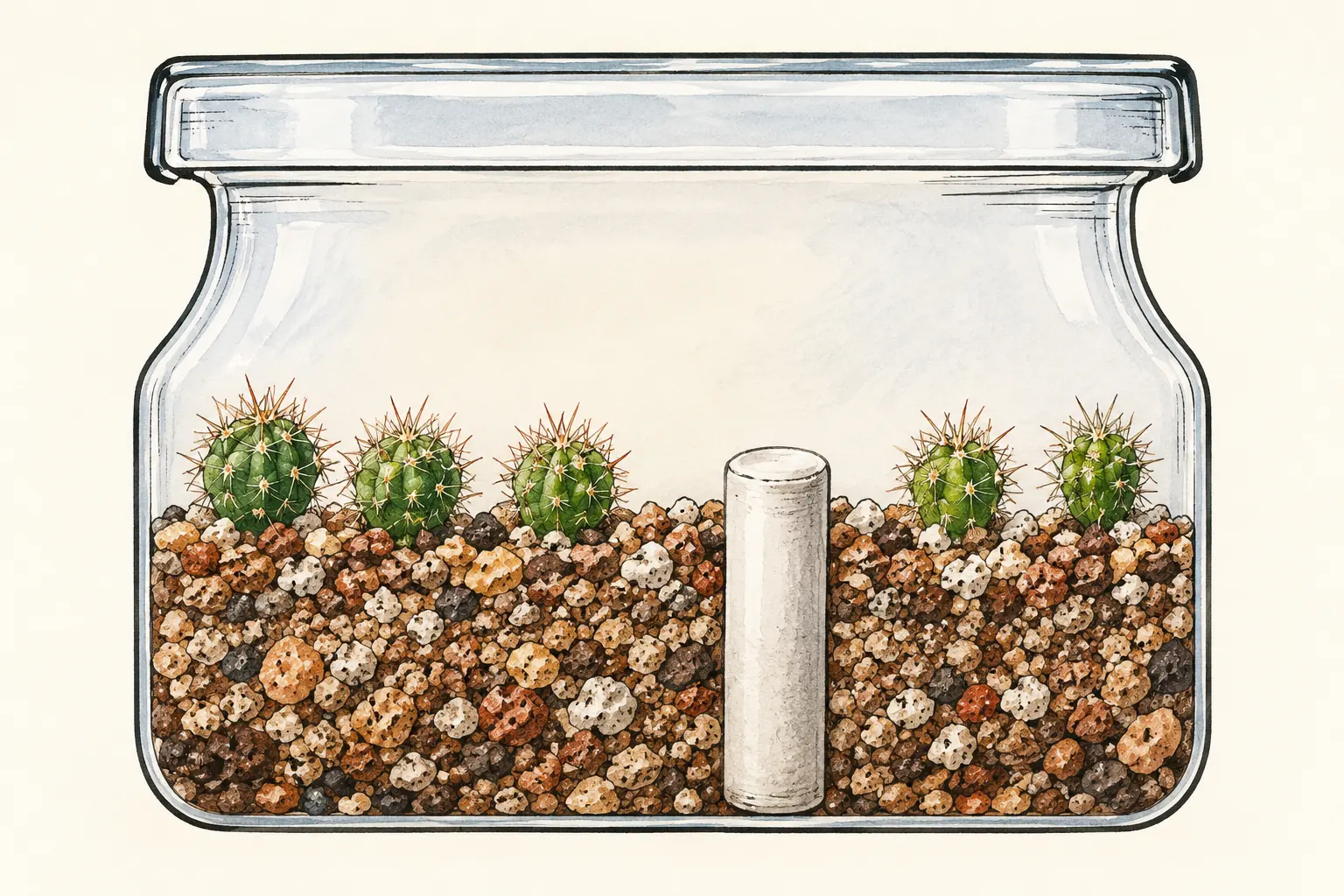
Sowing in a closed container
A closed container maintains a moist environment around the sowing. [Fleischer and Schütz 1978]
Closure does not guarantee sterility. The visible condition of seedlings does not determine when the container should be opened.
Enlarge plate ↗A closed container limits evaporation and moisture fluctuations. It does not automatically create sterile conditions. Contamination introduced with seeds or substrate remains inside. Traditional enclosed sowing requires hygienic preparation, observation of emergence and responses to developing patches of death. Droplets on the wall alone do not determine appropriate root-ball hydration. [Fleischer and Schütz 1978, pp. 163–180]

Seedlings under cover
Small seedlings under a transparent cover that reduces evaporation. [Fleischer and Schütz 1978]
This is a mini greenhouse for sowing. Ventilation and exposure are adjusted to seedling development. The cover does not replace temperature control.
Enlarge plate ↗A mini-greenhouse provides similar protection, with adjustable ventilation. Humidity, temperature and light act together. A covered container should not overheat in direct sun. Choose covering level and removal rate according to seedling development and substrate drying speed. Opening changes growing conditions, so delicate plants should not be moved abruptly from high humidity to a dry, strongly lit environment. [Fleischer and Schütz 1978, pp. 163–180] [Delgado-Sánchez et al. 2013]
To compare methods, record the number of seeds sown, emergence timing and counts, mortality and conditions near the covering. A dense green sowing in an illustration alone does not confirm the effectiveness of a particular substrate or opening time. Damping-off differentiation is discussed further in the chapter on fungi and oomycetes. [Fleischer and Schütz 1978, pp. 163–180, 186–188]
Temperature and seed history
Germination temperature interacts with water availability. An experiment with Echinocactus platyacanthus compared constant 25 and 32°C and three water potentials from 0 to −0.4 MPa. Each combination included five replicates of ten seeds. At 32°C and −0.4 MPa, germination remained inhibited for 30 days. For the seed batch tested, lower temperature favoured both a greater germination percentage and faster embryonic-root emergence. [González-Salvatierra et al. 2026]
The result also depends on material provenance and history. In Homalocephala parryi (formerly Echinocactus parryi), cooling for 20 days at 5°C preceded greenhouse sowing. After 50 days, 44% of seeds stored for a year and 32% stored for a month had germinated. Batches came from different harvest years, so seed age remained linked to conditions during their formation. The species card describes experimental details and seedling development. [Vargas-Luna et al. 2026]
Light and temperature when sowing Selenicereus setaceus
In Selenicereus setaceus, germination has requirements distinct from subsequent plant growth. Simão and colleagues studied seeds from three plants in a Brazilian seasonal forest on moistened filter paper. The most favourable range was 25–30°C. Responses to low light exposure and canopy-filtered light support sowing with access to diffuse light. Germination, seedling survival and cultivation of older plants are considered separately. [Simão et al. 2007, p. 656–660]
Phytochrome and epiphytic cactus germination
Simão, Nakamura and Takaki studied Epiphyllum phyllanthus seeds at different temperatures and under different lighting treatments. The material germinated across a broad temperature range, with complete germination recorded at 15–30°C. Seeds responded even to the dim green light used during assessment. This was associated with a very-low-fluence phytochrome response. Some seeds also germinated in complete darkness, which the authors related to the initial proportion of active phytochrome. [Simão et al. 2010, pp.115–119, methods and results]
The Epiphyllum phyllanthus study distinguished complete darkness from a treatment in which seeds were assessed under dim green light. This detail influenced interpretation of the light response. Phytochrome is a photoreceptor whose state changes with radiation. The result obtained for a particular species and seed batch helps explain the mechanism initiating germination. [Simão et al. 2010, pp.116–119]
The book chapter on sexual propagation, pages 163–180, the entire older sowing page, the archival seedling-care text and material on germination physiology were read. The data were compared with the 2020 review by Barrios and co-authors. Historical pesticides, routine antibiotics, acid treatment and recipes using uncertain construction waste were omitted. The addition on apomixis follows the introduction to Liu et al. 2024, retaining the distinction between seed formation and confirmed crossing.
Kaktusy
[Fleischer Z., Schütz B., Kaktusy, Państwowe Wydawnictwo Rolnicze i Leśne, Warszawa, 1978, wyd. I, trans. Kabiesz Z., Prajer Z.]
Państwowe Wydawnictwo Rolnicze i Leśne, Warsaw, first edition. Translated by Zofia Kabiesz and Zbigniew Prajer. Historical and cultivation background. Names and interpretations updated separately.
Methods and experiments described
Budowa, fizjologia i rozmnażanie kaktusów
[Autor nieustalony, Budowa, fizjologia i rozmnażanie kaktusów, b.d.f]
Material from an older website, preserved in Konrad Szychowski's private archive. It covers cactus structure, physiology and propagation.
Wysiew, sadzonkowanie i szczepienie kaktusów
[Autor nieustalony, Wysiew, sadzonkowanie i szczepienie kaktusów, b.d.ac]
Texts and documents from Konrad Szychowski's private archive. They cover cactus sowing, seedling care, cuttings and grafting, and cultivation observations.
Seed traits and germination in the Cactaceae family — a review across the Americas
Barrios D., Sánchez J. A., Flores J., Jurado E., Seed traits and germination in the Cactaceae family — a review across the Americas, Botanical Sciences, 2020, 98(3):417-440, doi: 10.17129/botsci.2501
The review compares effects of light and temperature on cactus germination. It covers seed dormancy, longevity and seed banks.
Genomic insights into the clonal reproductive Opuntia cochenillifera — mitochondrial and chloroplast genomes of the cochineal cactus for enhanced understanding of structural dynamics and evolutionary implications
Liu J., Feng Y., Chen C., Yan J., Bai X., Li H., Lin C., Xiang Y., Tian W., Qi Z., Yu J., Yan X., Genomic insights into the clonal reproductive Opuntia cochenillifera — mitochondrial and chloroplast genomes of the cochineal cactus for enhanced understanding of structural dynamics and evolutionary implications, Frontiers in Plant Science, 2024, 15:1347945, doi: 10.3389/fpls.2024.1347945
The paper presents mitochondrial sequence reconstruction and organelle genome comparisons. It discusses genomic data organisation in the material studied.
Ecophysiological and Anatomical Mechanisms behind the Nurse Effect: Which Are More Important? A Multivariate Approach for Cactus Seedlings
Delgado-Sánchez P., Yáñez-Espinosa L., Jiménez-Bremont J. F., Chapa-Vargas L., Flores J., Ecophysiological and Anatomical Mechanisms behind the Nurse Effect: Which Are More Important? A Multivariate Approach for Cactus Seedlings, PLOS ONE, 2013, 8(11):e81513, doi: 10.1371/journal.pone.0081513
The study of Opuntia streptacantha seedlings compares lighting and watering treatments. The results show the interaction of water and light availability in early plant development.
Sensitivity of Chihuahuan Desert cacti to heat and water limitation during germination
González-Salvatierra C., Zárate-Camargo G., Cach-Pérez M. J., Flores J., Sensitivity of Chihuahuan Desert cacti to heat and water limitation during germination, Flora, 2026, 341:153012, doi: 10.1016/j.flora.2026.153012
A comparison of germination in five cactus species at 25 and 32°C and water potentials of 0, −0.2 and −0.4 MPa. The paper presents germination percentage, timing and progress, revealing large differences in species responses to temperature and limited water availability.
Effect of preconditioning treatments and seed storage time on Homalocephala parryi (Cactaceae) germination in greenhouse conditions
Vargas-Luna M. D., Lazo-Anchondo G., De La Torre S., Aristizábal J. F., Figueroa C., Effect of preconditioning treatments and seed storage time on Homalocephala parryi (Cactaceae) germination in greenhouse conditions, Acta Botanica Mexicana, 2026, 133:e2529, doi: 10.21829/abm133.2026.2529
A greenhouse experiment with seeds from one Homalocephala parryi population in Chihuahua. Two lots with different storage durations, soaking and pretreatment at 5°C were compared. The highest germination was obtained after chilling seeds stored for a year. The paper also describes fruits, seed structure and development of the seedling's first areoles. The lots came from different collection years.
The epiphytic cactaceae Hylocereus setaceus (Salm-Dick ex DC.) Ralf Bauer seed germination is controlled by light and temperature
Simão E., Socolowski F., Takaki M., The epiphytic cactaceae Hylocereus setaceus (Salm-Dick ex DC.) Ralf Bauer seed germination is controlled by light and temperature, Brazilian Archives of Biology and Technology, 2007, 50(4):655-662, doi: 10.1590/S1516-89132007000400011
Light, temperature and phytochrome in Selenicereus setaceus seed germination.
The germination of seeds of Epiphyllum phyllanthus (L.) Haw. (Cactaceae) is controlled by phytochrome and by nonphytochrome related process
Simão E., Nakamura A. T., Takaki M., The germination of seeds of Epiphyllum phyllanthus (L.) Haw. (Cactaceae) is controlled by phytochrome and by nonphytochrome related process, Biota Neotropica, 2010, 10(1):115-119, doi: 10.1590/S1676-06032010000100011
Effects of light, temperature and phytochrome state on Epiphyllum phyllanthus germination.
Oklahoma State University Extension
https://extension.okstate.edu/
Materials on substrates, containers and hydroponics.
Accessed 2026-10-08.
University of California Integrated Pest Management
Identification of plant problems and principles of integrated pest management.
Accessed 2026-10-08.


