Tubercle, areole and axil
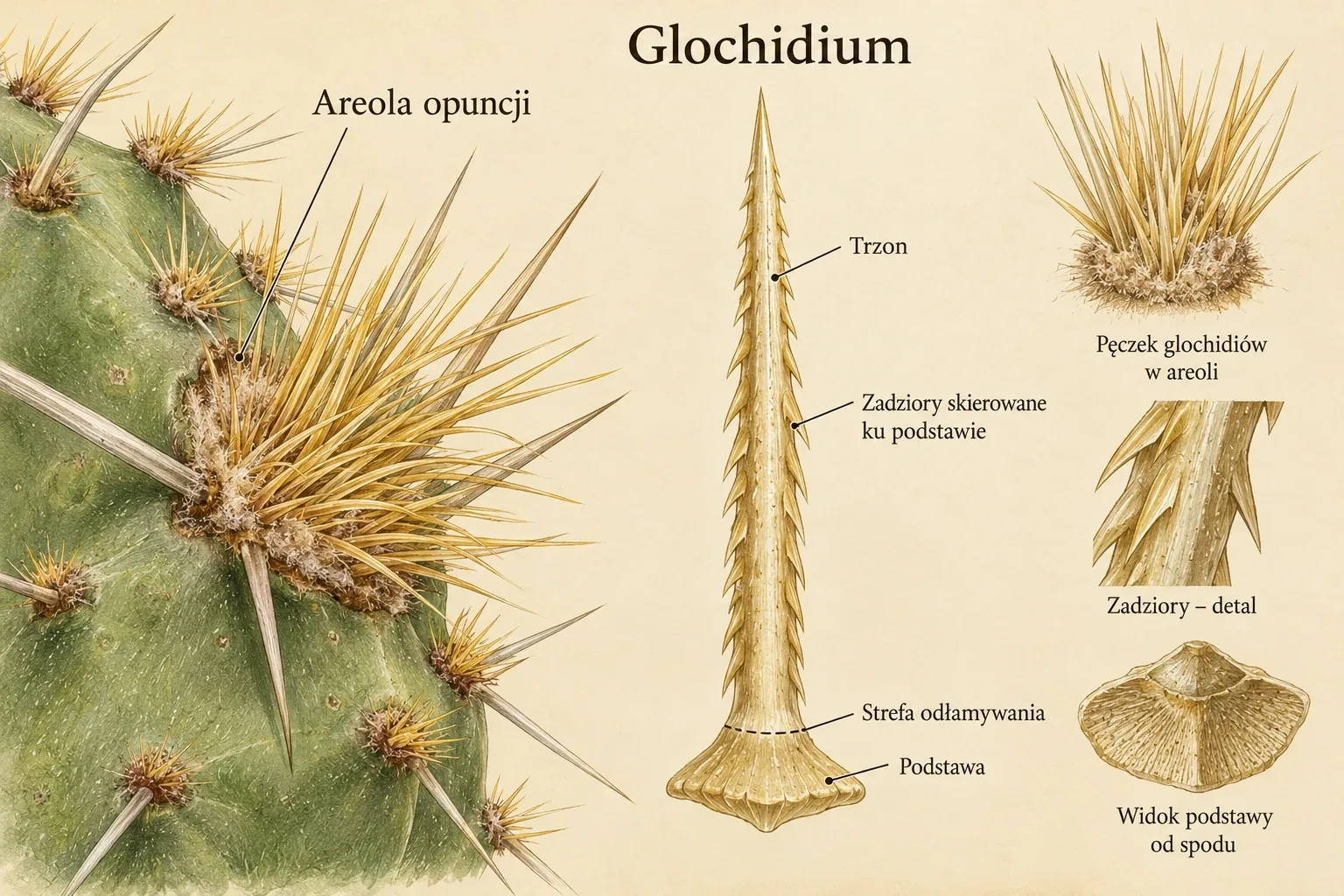
A tubercle is a projection of the stem, rather than a spine. In Mammillaria, the spine-producing zone is at its apex, while flowers appear near the axil between tubercles. The shape of the green body should be distinguished from spine length, wool quantity and the density of neighbouring tubercles. Together, these traits create the plant's appearance, but describe different structures. [Mauseth 2006] [Fleischer and Schütz 1978, pp. 26–28]

Tubercle shape and distribution
The comparison combines tubercle shape, tip form and density of distribution. [Britton and Rose 1923] [Mauseth 2006]
The traits are not mutually exclusive. The images are not portraits of identified species. Botanical examples are described in the text.
Enlarge plate ↗How to compare the eight diagrams
The plates organise descriptive vocabulary rather than establish eight taxonomic groups. Conical shape, a rounded tip, flattening and close spacing can apply to the same tubercle. The examples below refer to traits recorded in sources. They do not identify the species in the illustration. The label “awl-shaped” particularly requires commentary, because it has not been confirmed as a separate category for the example indicated. [Britton and Rose 1923]
| Trait compared | Example | Basis of interpretation |
|---|---|---|
| Short-conical | Mammillaria mammillaris | Morphological description [Britton and Rose 1923, p. 70], current name [2-WWW] |
| Elongated | Mammillaria longimamma | Morphological description [Britton and Rose 1923, pp. 61–63], current name [2-WWW] |
| Cylindrical and rounded | Mammillaria bocasana | Morphological description [Britton and Rose 1923, p. 147], current name [2-WWW] |
| Slender and strongly tapering | Mammillaria longimamma, comparison of elongation | Morphological description [Britton and Rose 1923, pp. 61–63], current name [2-WWW] |
| Blunt-tipped | Mammillaria heyderi subsp. gaumeri | Morphological description [Britton and Rose 1923, pp. 72–73], current name [2-WWW] |
| Angular, approaching pyramidal | Mammillaria polyedra | Morphological description [Britton and Rose 1923, pp. 102–103], current name [2-WWW] |
| Laterally flattened | Mammillaria compressa | Morphological description [Britton and Rose 1923, pp. 90–92], current name [2-WWW] |
| Densely arranged | Mammillaria evermanniana | Morphological description [Britton and Rose 1923, p. 97], current name [2-WWW] |
Short-conical

Short-conical
Schematic trait. Short-conical. Example and scope of comparison. Mammillaria mammillaris. [Britton and Rose 1923] [2-WWW]
The drawing is a geometric model without a scale or identified specimen. It is not used to identify the species.
Enlarge plate ↗Example, Mammillaria mammillaris. The tubercle has a broad base and tapers towards the areole. Britton and Rose described short conical tubercles in this species, nearly rounded in cross-section. “Short” refers to the tubercle's projection beyond the stem axis, rather than spine length. [Britton and Rose 1923, p. 70] [2-WWW]
Elongated

Elongated conical
Schematic trait. Elongated. Example and scope of comparison. Mammillaria longimamma. [Britton and Rose 1923] [2-WWW]
The drawing is a geometric model without a scale or identified specimen. It is not used to identify the species.
Enlarge plate ↗Example, Mammillaria longimamma. Marked tubercle elongation changes the silhouette of the whole plant. In the monograph, the species appears as Dolichothele longimamma. This is an example of elongation, rather than proof that every tubercle has the perfectly conical outline drawn on the plate. [Britton and Rose 1923, pp. 61–63] [2-WWW]
Cylindrical and rounded

Cylindryczne
Schematic trait. Cylindrical and rounded. Example and scope of comparison. Mammillaria bocasana. [Britton and Rose 1923] [2-WWW]
The drawing is a geometric model without a scale or identified specimen. It is not used to identify the species.
Enlarge plate ↗Example, Mammillaria bocasana. Slender tubercles with a rounded cross-section are partly obscured by hair-like spines in this species. Their shape is assessed on exposed green tissue, rather than the outline of the entire white covering. The boundary between a cylinder and an elongated cone is gradual in a living organ. [Britton and Rose 1923, p. 147] [2-WWW]
Slender and strongly tapering

Slender and tapering
Schematic trait. Slender and strongly tapering. Example and scope of comparison. Mammillaria longimamma, comparing elongation. [Britton and Rose 1923] [2-WWW]
The term “awl-shaped” in the drawing has not been confirmed as a separate diagnostic trait of the named species. The comparison concerns elongation.
Enlarge plate ↗Example, Mammillaria longimamma, comparison of elongation. The label “awl-shaped” in the drawing presents an extreme geometric model of slenderness and tapering. M. longimamma can be used to compare elongation. However, the source description read does not establish a separate “awl-shaped type” for this species. The label is therefore not assigned to the species as a diagnostic trait. This panel requires the most cautious interpretation. [Britton and Rose 1923, pp. 61–63] [2-WWW]
Blunt-tipped

Blunt-tipped
Schematic trait. Blunt-tipped. Example and scope of comparison. Mammillaria heyderi subsp. gaumeri. [Britton and Rose 1923] [2-WWW]
The drawing is a geometric model without a scale or identified specimen. It is not used to identify the species.
Enlarge plate ↗Example, Mammillaria heyderi subsp. gaumeri. The taxon, originally described as Neomammillaria gaumeri, has short, almost rounded tubercles with a blunt tip. “Rounded” in the illustration should refer to the apex and outline, rather than treating the entire tubercle as a sphere. The subspecies designation preserves its scope in the current POWO treatment. [Britton and Rose 1923, pp. 72–73] [2-WWW]
Angular, approaching pyramidal

Piramidalne
Schematic trait. Angular, approaching pyramidal. Example and scope of comparison. Mammillaria polyedra. [Britton and Rose 1923] [2-WWW]
The drawing is a geometric model without a scale or identified specimen. It is not used to identify the species.
Enlarge plate ↗Example, Mammillaria polyedra. This species has been described with angular, pointed tubercles flattened on the dorsal side. Their shape can be compared with a pyramid, but this is a model. The same tubercle combines angularity and flattening. Such coexistence of traits shows why the plate's eight labels cannot be treated as a mutually exclusive classification. [Britton and Rose 1923, pp. 102–103] [2-WWW]
Laterally flattened

Flattened
Schematic trait. Laterally flattened. Example and scope of comparison. Mammillaria compressa. [Britton and Rose 1923] [2-WWW]
The drawing is a geometric model without a scale or identified specimen. It is not used to identify the species.
Enlarge plate ↗Example, Mammillaria compressa. The tubercles are described as short and laterally flattened, with a keel below and a more rounded upper side. The direction of flattening must therefore be specified. The word “flat” alone does not convey the asymmetry of the two surfaces. Views from above and from the side may give different impressions. [Britton and Rose 1923, pp. 90–92] [2-WWW]
Densely arranged

Densely arranged
Schematic trait. Densely arranged. Example and scope of comparison. Mammillaria evermanniana. [Britton and Rose 1923] [2-WWW]
The drawing is a geometric model without a scale or identified specimen. It is not used to identify the species.
Enlarge plate ↗Example, Mammillaria evermanniana. In the original description of Neomammillaria evermanniana, the tubercles are rounded and closely set, almost covered by numerous spines. Density is an arrangement trait, rather than the shape of an individual tubercle. It can coexist with any of several preceding traits. [Britton and Rose 1923, p. 97] [2-WWW]
From historical name to current label
The 1923 monograph used placed most examples in the genus Neomammillaria and described the elongated tubercles of M. longimamma under Dolichothele. Current names were checked in POWO. The species studied by historical authors is not silently changed. The old combination is retained, and the name under which the same taxon can now be found is indicated. [Britton and Rose 1923] [2-WWW] [2-WWW]
Tubercle shape is one identification trait. Comparing taxa also requires areoles, spines, flowers, fruits, seeds and the material's origin. An illustration without specimen data, scale and variation is not treated as a standalone botanical key. [Mauseth 2006] [Britton and Rose 1923]
Morphology was compared with descriptions in volume IV of The Cactaceae (1923), and current names were checked in POWO on 9.10.2026. The illustrations come from material supplied by the site author and do not depict identified specimens.
The Cactaceae: Descriptions and Illustrations of Plants of the Cactus Family. Volume IV
[Britton N. L., Rose J. N., The Cactaceae: Descriptions and Illustrations of Plants of the Cactus Family. Volume IV, Carnegie Institution of Washington, Washington, 1923, tom IV]
Volume IV of the 1923 monograph contains descriptions of cacti, including tubercle structure and historical name combinations. The supplied copy comes from Konrad Szychowski's private archive.
Kaktusy
[Fleischer Z., Schütz B., Kaktusy, Państwowe Wydawnictwo Rolnicze i Leśne, Warszawa, 1978, wyd. I, trans. Kabiesz Z., Prajer Z.]
Państwowe Wydawnictwo Rolnicze i Leśne, Warsaw, first edition. Translated by Zofia Kabiesz and Zbigniew Prajer. Historical and cultivation background. Names and interpretations updated separately.
Structure–Function Relationships in Highly Modified Shoots of Cactaceae
Mauseth J. D., Structure–Function Relationships in Highly Modified Shoots of Cactaceae, Annals of Botany, 2006, 98(5):901-926, doi: 10.1093/aob/mcl133
The review describes cactus stem structure, areoles, and photosynthetic and storage tissues. It explains connections between anatomy, photosynthesis and water storage.
Plants of the World Online — Royal Botanic Gardens, Kew
Accepted names, synonyms and distribution. A citation beside a taxon leads to its record.
Accessed 2026-10-08.