What changes in the meristem
The shoot apical meristem contains cells initiating successive axis sections and organ primordia. In cacti, its size and pattern of new-primordium placement relate to tubercle and rib arrangement. Studies of Carnegiea gigantea and Kroenleinia grusonii show that organ-row number may change during development. Increasing rib number alone does not indicate disease. This normal variation must be distinguished from a lasting change in growing-zone geometry. [Mauseth 2025] [Mauseth 2006]
Cristata, growth along a crest
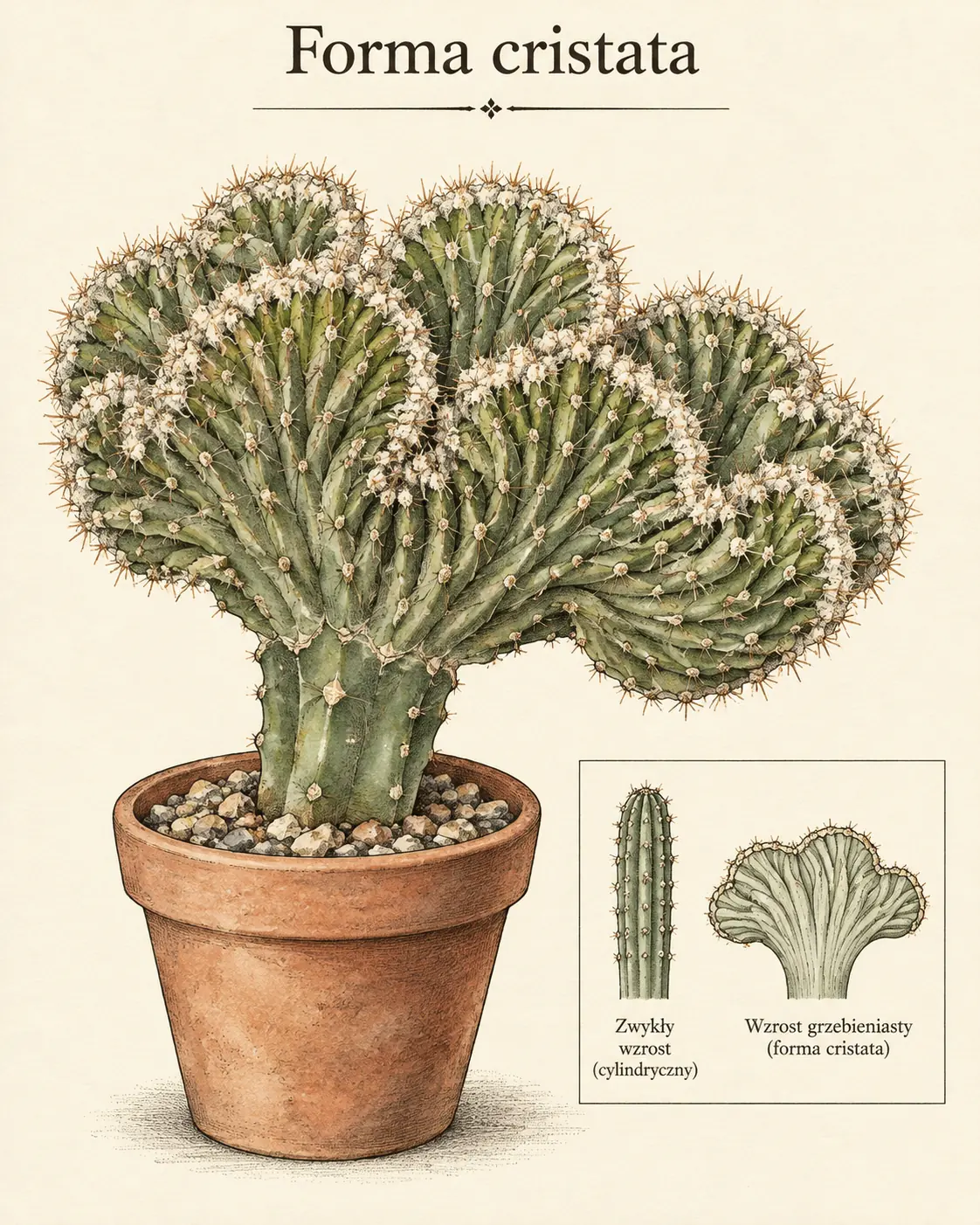
Cristate form
A flattened, folded stem illustrates growth along an elongated apical zone. [Iliev and Kitin 2011] [Fleischer and Schütz 1978]
The drawing describes a growth form. It does not identify the species or cause of fasciation.
Enlarge plate ↗In the crested form, termed horticulturally cristata, the apical region extends into an elongated meristematic zone. The growing axis is flattened and may form a fan, wavy crest or folded band. Tubercles and areoles still form, but their arrangement follows the altered meristem shape. The phenomenon is fasciation, or flattening into a band. It does not mechanically fuse several normal adult shoots. [Mauseth 2006] [Fleischer and Schütz 1978, pp. 24–25]
Multiple heads are insufficient to identify cristata. Apex division may produce two separate, regularly growing shoots, while a persistent crest retains an elongated growth zone. Offsets emerging from areoles after tip damage are likewise ordinary branching as long as their own growth remains regular. Successive growth observations resolve this, not a single plant outline. [Mauseth 2006] [Hinz and Abramowicz 1986, pp. 28–32]
Monstruosa, several kinds of irregularity

Monstrous form
Irregular growth and branching illustrate a monstrose form. [Fleischer and Schütz 1978] [Hinz and Abramowicz 1986]
The phrase “lack of symmetry” is a simplification. Altered and regular sections may coexist.
Enlarge plate ↗“Monstrous form” covers various persistent habit deviations, including irregular elongation rhythm, knobbly growth, altered rib or tubercle arrangement and unusual branching. It does not name one developmental mechanism. A plant may retain regular axis portions beside strongly altered regions, so “lack of symmetry” in an illustration should be understood descriptively. Cristata and monstruosa are sometimes grouped in trade, but the first primarily indicates crested growth organization. [Mauseth 2006] [Hinz and Abramowicz 1986, pp. 28–32]
Adding cristata or monstruosa to a label does not automatically establish a formal botanical variety or one cultivar. Similar appearance may arise in independent lineages. The most useful collection record includes accepted species name, growth-form designation, plant provenance and clone identifier. The plate depicts growth form. Species identification requires additional traits and provenance information. [Turland et al. 2025] [Hinz and Abramowicz 1986, pp. 28–32]
Genetic cause, injury or infection
Interpreting unusual forms requires distinguishing a change in the growth programme from the factor that triggered it. The change may affect only part of the meristem and persist through vegetative propagation. An injury, meanwhile, may destroy the dominant apex and activate new axes without causing lasting fasciation. A crest appearing after damage does not prove a specific mutation. Historical explanations attributing all cases to one cause are too categorical. [Mauseth 2006] [Hinz and Abramowicz 1986, pp. 28–32]
Omar, Dewir and El-Mahrouk studied fasciated succulents and detected phytoplasma DNA using nested PCR and sequencing. The material included one cactus, described as Opuntia cylindrica, and plants from other families. Hormone profiles also changed, but not uniformly in all the hosts studied. The result documents the coexistence of infection and abnormal growth in specific material. It does not justify considering every cristata infected or treating all the succulents studied as cacti. [Omar et al. 2014]
Maliarenko and Mudrak found virus-like particles in a small sample of nine materials comprising fasciated forms and rootstocks. Identification relied on particle morphology and biological assays. The presence of such particles in ordinary rootstocks too, and the absence of an experiment reproducing fasciation, prevent attributing the trait studied to viruses. Statistical association, pathogen detection and demonstration of causation are different levels of evidence. [Maliarenko and Mudrak 2013]
Genes and growth regulators. Scope of the evidence
The review by Iliev and Kitin shows that similar fasciation can arise through different pathways. In model plants, changes in the CLAVATA gene system, which regulates meristem organisation, are associated with excessive meristem growth. A similar phenotype has also been obtained through the action of growth regulators in in vitro cultures. The authors also discuss such experiments with Mammillaria elongata. This does not mean that a CLAVATA mutation has been identified in every purchased cristata or that its shape can reveal a single cause. [Iliev and Kitin 2011]
The shared outcome is a change in the size and spatial organisation of the meristematic tissue. Subsequent anatomy depends on the species and course of development. A statement in an older book that fasciation has never been induced experimentally no longer reflects the full state of knowledge. However, a result from a controlled tissue culture must be distinguished from a spontaneous change in a collection. [Iliev and Kitin 2011] [Hinz and Abramowicz 1986, p. 32]
Inheritance and maintenance of a clone
Retention of a trait in a cutting does not prove that it will be transmitted through seeds. A cutting reproduces a fragment of the altered plant, whereas sexually produced offspring arise after meiosis and fertilisation. Which cells carry the change, and whether they take part in gamete formation, matters. However, this distinction should not be replaced with the opposite rule that cristata is always an exclusively acquired trait. Such a general claim in an old guide must be rejected without data on the specific line and its offspring. [Mauseth 2006] [Hinz and Abramowicz 1986, p. 32]
Grafting can help maintain a poorly growing scion, but it does not remove its developmental cause and is not a virus elimination procedure. Trait stability is assessed over successive seasons, recording crested and irregular sectors and those reverting to ordinary growth. If new discolouration, growth inhibition or symptoms on the rootstock appear at the same time, the health of the material must be investigated separately. [Maliarenko and Mudrak 2013] [Fleischer and Schütz 1978, pp. 181–186]
Fasciation in Ortegocactus cultures
In Ortegocactus macdougallii (treated in some more recent classifications as Cochemiea macdougallii), crested and monstrous shoots were observed in tissue culture with a combination of NAA at 4.4 µM and BA at 19.9 or 26.6 µM. Lower BA at 13.3 µM produced longer shoots, and increasing the concentration did not significantly increase their number. The 2013 experiment by Arellano-Perusquía and colleagues documents a relationship between shoot form and medium treatment. Persistence of the altered form after acclimatisation and its molecular cause require separate studies. [Arellano-Perusquía et al. 2013, Arellano-Perusquía et al., pp. 163–165, Table 2; Breslin et al., p. 319][Breslin et al. 2021, Arellano-Perusquía et al., pp. 163–165, Table 2; Breslin et al., p. 319]
Mammillaria elongata. Regeneration of crests and ordinary shoots
In the 2001 experiment by Papafotiou and colleagues, ordinary and crested Mammillaria elongata differed in their responses to explant position and growth regulators. Explants were taken from two-year-old stock plants maintained in an unheated greenhouse. Cultures were grown on MS with sucrose at 20 g/l, at 25°C, with a sixteen-hour photoperiod and 37.5 µmol photons/m²/s. Each treatment comprised 15 or 18 explants. The experiments were repeated twice, and the tables present one of them. [Papafotiou et al. 2001, pp. 163–165]
In the ordinary form, single-tubercle explants from the upper part of the stem first produced callus and then shoots. With NAA at 1.07 µM and BA at 22.19 µM, shoots formed after 60 days on 88% of explants collected in October and 35% collected in February. The stock plants had different greenhouse conditions in those months, with reported mean temperatures of 22 and 10°C, respectively. The result indicates a seasonal difference in the response of this material, also encompassing the plant's previous condition. [Papafotiou et al. 2001, p. 164, Table 1]
In the crested form, explants from the crest itself, designated T, had four tubercles. Explants from the strip up to 1 cm below it, bT, had three. With NAA at 0.54 µM and BA at 0.44 µM in October, all T explants initially produced an enlarged crested shoot, whereas 25% of bT showed this response. By contrast, an ordinary shoot appeared directly on 53% of bT. The collection site therefore affected the resulting direction of growth. [Papafotiou et al. 2001, pp. 164–165, Table 2a]
After the enlarged crests were transferred to basal MS, shoots of both forms developed. Callus from a crested plant also regenerated a mixture of ordinary and crested shoots, often with symptoms of hyperhydricity. For crested shoots shorter than 1 cm, rooting was 67% with IBA at 0.98 µM, and subsequent acclimatisation of previously rooted shoots was 90–100%. After two years, around 80% of the resulting crested plants retained this form, while ordinary shoots also appeared on the others. The exact size of this final cohort was not reported. [Papafotiou et al. 2001, pp. 165–167]
The experiment shows that the form of daughter shoots depends on the plant region and the course of regeneration. The hypothesis of local hormonal regulation within the elongated meristem agrees with some observations, but endogenous hormones and DNA changes were not measured in this study. The results concern propagation of existing cristata material and its subsequent development. Inheritance through seeds and the initial cause of fasciation require separate data. [Papafotiou et al. 2001, p. 167]
Prepared from the cited studies and supplied book excerpts. Historical names and recommendations are distinguished from current findings. The extent of access to each publication is stated in the bibliography.
Constant distance between leaf initiation sites permits non-destructive analysis of apical meristem activity during cactus shoot growth
Mauseth J. D., Constant distance between leaf initiation sites permits non-destructive analysis of apical meristem activity during cactus shoot growth, Annals of Botany, 2025, 136(1):229-241, doi: 10.1093/aob/mcaf085
The study analyses meristem organisation and organ placement during the growth of two cactus species. It links activity at the apex with changes in rib organisation.
Cactus viruses in fasciated plants
Maliarenko V. M., Mudrak T. P., Cactus viruses in fasciated plants, Biologija, 2013, 59(2):213-218, doi: 10.6001/biologija.v59i2.2754
The article analyses nine samples of fasciated plants and rootstocks for the presence of viruses. Identification of the particles is based on morphology and biological assays.
Molecular identification of phytoplasmas in fasciated cacti and succulent species and associated hormonal perturbation
Omar A. F., Dewir Y. H., El-Mahrouk M. E., Molecular identification of phytoplasmas in fasciated cacti and succulent species and associated hormonal perturbation, Journal of Plant Interactions, 2014, 9(1):632-639, doi: 10.1080/17429145.2014.882421
The paper brings together phytoplasma sequences and hormone profiles in four succulents. One of the species studied belonged to Cactaceae.
Structure–Function Relationships in Highly Modified Shoots of Cactaceae
Mauseth J. D., Structure–Function Relationships in Highly Modified Shoots of Cactaceae, Annals of Botany, 2006, 98(5):901-926, doi: 10.1093/aob/mcl133
The review describes cactus stem structure, areoles, and photosynthetic and storage tissues. It explains connections between anatomy, photosynthesis and water storage.
Kaktusy
[Fleischer Z., Schütz B., Kaktusy, Państwowe Wydawnictwo Rolnicze i Leśne, Warszawa, 1978, wyd. I, trans. Kabiesz Z., Prajer Z.]
Państwowe Wydawnictwo Rolnicze i Leśne, Warsaw, first edition. Translated by Zofia Kabiesz and Zbigniew Prajer. Historical and cultivation background. Names and interpretations updated separately.
Uprawa kaktusów
[Hinz S., Abramowicz M., Uprawa kaktusów, Wydawnictwo Glob, Szczecin, 1986, s. 28–32, 89–112 (udostępnione fragmenty)]
The guide covers cactus structure, growth forms, propagation, cultivation conditions and plant protection. Supplied excerpts describe crested and monstrose forms, winter hardiness, and identification of damage and diseases, among other subjects. Plant protection recommendations document practice at the time of publication.
International Code of Nomenclature for algae, fungi, and plants (Madrid Code)
[Turland N. J., Wiersema J. H., Barrie F. R., Gandhi K. N., Gravendyck J., Greuter W., Hawksworth D. L., Herendeen P. S., Klopper R. R., Knapp S., Kusber W. H., Li D. Z., May T. W., Monro A. M., Prado J., Price M. J., Smith G. F., Zamora Señoret J. C. (red.), International Code of Nomenclature for algae, fungi, and plants (Madrid Code), Regnum Vegetabile, University of Chicago Press, Chicago, 2025, tom 162]
Current international rules for scientific plant names. The edition published on 21 July 2025 replaced the Shenzhen Code. The full editorial committee is listed in the bibliography. The Code establishes nomenclatural rules, rather than one permissible classification of relationships.
Origin, morphology, and anatomy of fasciation in plants cultured in vivo and in vitro
Iliev I., Kitin P., Origin, morphology, and anatomy of fasciation in plants cultured in vivo and in vitro, Plant Growth Regulation, 2011, 63(2):115-129, doi: 10.1007/s10725-010-9540-3
The review compares the causes and anatomical forms of fasciation. It discusses genetic changes and responses to environmental conditions and growth regulators.
Effect of growth regulators on the organogenesis and multiplication of Ortegocactus macdougallii Alexander
Arellano-Perusquía A., López-Peralta M. C. G., Chablé-Moreno F., Estrada-Luna A. A., Effect of growth regulators on the organogenesis and multiplication of Ortegocactus macdougallii Alexander, Propagation of Ornamental Plants, 2013, 13(4):160-167
Experiments on micropropagating Ortegocactus macdougallii from tubercles of adult plants. The authors observe activation of areole meristems and adventitious bud formation outside areoles. They compare BA and NAA combinations during initiation and multiplication, and MS medium dilution and IBA during rooting. Higher BA doses were associated with fasciation in some shoots, and the highest proportion of rooted explants was about 75% after 50 days.
Molecular phylogeny of the Mammilloid clade (Cactaceae) resolves the monophyly of Mammillaria
Breslin P. B., Wojciechowski M. F., Majure L. C., Molecular phylogeny of the Mammilloid clade (Cactaceae) resolves the monophyly of Mammillaria, Taxon, 2021, 70(2):308-323, doi: 10.1002/tax.12451
A reconstruction of mammilloid clade phylogeny from the large single-copy region of the plastid genome, using maximum likelihood, maximum parsimony and Bayesian inference. The sample contains 88 specimens representing 78 taxa, and the analysis is supported by morphological character state reconstructions. The authors propose new boundaries for Mammillaria, Cochemiea and Coryphantha and discuss the separate position of Mammillaria sphacelata, now Oehmea sphacelata.
In vitro plant regeneration of Mammillaria elongata normal and cristate forms
Papafotiou M., Balotis G. N., Louka P. T., Chronopoulos J., In vitro plant regeneration of Mammillaria elongata normal and cristate forms, Plant Cell, Tissue and Organ Culture, 2001, 65(2):163-167, doi: 10.1023/A:1010601328667
A comparison of regeneration in ordinary and crested forms of Mammillaria elongata from tubercle explants. The authors examine section position, collection date, NAA and BA concentrations, direct and callus-mediated regeneration, and rooting. Two-year observations show crest retention in some plants and the appearance of ordinary shoots. The paper discusses local growth organisation and the hypothetical role of hormonal regulation in fasciation.


