From tubercle to new shoot
Ortegocactus macdougallii is the only species of the genus currently accepted by Plants of the World Online. Its natural range lies in Oaxaca. Publications adopting a broadly circumscribed Cochemiea use the name Cochemiea macdougallii. The results of the earlier paper by Arellano-Perusquía and co-authors concern the same plant. The experiment published in 2013 tracked the response of small stem fragments to growth regulators, followed by multiplication of the resulting shoots and root formation. These stages were assessed separately, because the response leading to bud formation differed from the conditions favouring subsequent growth and rooting. [Arellano-Perusquía et al. 2013, Arellano-Perusquía et al., pp. 160–161; Breslin et al., p. 319; POWO, genus and species accounts][2-WWW][2-WWW][Breslin et al. 2021, Arellano-Perusquía et al., pp. 160–161; Breslin et al., p. 319; POWO, genus and species accounts]
The material came from seven-year-old plants purchased from a nursery. They were kept in a greenhouse for a year, after which young shoots 0,5–1,5 cm long were collected. After disinfection, individual tubercles or fragments with several tubercles were cut out, containing one to three areoles. Such an explant already contained sites with areolar meristems and tissues between them. The authors could therefore compare activation of existing growth points with the appearance of buds in other parts of the fragment. [Arellano-Perusquía et al. 2013, p. 161, Plant material, Micropropagation]
A common culture environment with varying regulators
The basal medium was MS, developed by Murashige and Skoog. All its treatments contained 5% sucrose and 0,7% agar. The pH was set at 5,7. Cultures were maintained at 27 ± 3°C with a sixteen-hour day under white fluorescent lamps, at a photosynthetic photon flux density of approximately 50 µmol m−2 s−1. These conditions were common to the experiment with tissues growing in containers on a sugar-containing medium. The responses given below apply to this environment and the material used. [Arellano-Perusquía et al. 2013, p. 161, Culture conditions]
In the first stage, the cytokinin BA, N6-benzyladenine, was combined with the auxin NAA, α-naphthaleneacetic acid. Regulators were supplied individually or together at concentrations from the series 0, 1,3, 4,4 and 13,3 µM. Each treatment had six explants, and the response was assessed after 116 days. Callus, shoot and root formation were recorded. The limited initial number of plant fragments makes this stage a search for conditions allowing culture establishment. [Arellano-Perusquía et al. 2013, pp. 161–162, Micropropagation, Results]
Callus, areole activation and direct organogenesis
Treatments containing NAA induced callus formation. Initially, it was soft, friable, red or green. Later, it became hard and compact and grew slowly. Formation of this tissue indicated an explant response to the medium, while production of a shoot was a further, separately observed outcome. Shoots appeared only when BA 13,3 µM was combined with NAA 1,3 or 4,4 µM. In these two treatments, four explants formed a total of 17 shoots. BA alone at the concentrations used did not stimulate areolar buds to grow. [Arellano-Perusquía et al. 2013, pp. 162–163, Results, Table 1]
Stereoscopic examination revealed two pathways of shoot formation. One was activation of meristems present in areoles. The other involved the appearance of buds at the explant edges and base, and between tubercles, in sites without areoles. Shoots with small tubercles and the colour typical of young plants developed from these primordia. The authors described the second pathway as direct adventitious organogenesis, basing their identification on the sites where buds appeared and their development. [Arellano-Perusquía et al. 2013, pp. 162–165, Fig. 1B–G, Results, Discussion]
Distinguishing these pathways matters for clonal propagation. A shoot originating from an areole uses an existing meristem, while an adventitious shoot forms a new growth point. The publication documents their location and form visible in culture. The origin of new buds from specific cells and the genetic fidelity of the resulting plants are separate questions requiring anatomical or molecular studies. The description of the organogenetic pathway therefore needs to be linked to the observations actually performed. [Arellano-Perusquía et al. 2013, pp. 162–165, Fig. 1, Discussion]
Multiplication, shoot numbers and length
During multiplication, NAA was maintained at 4,4 µM and three BA concentrations of 13,3, 19,9 and 26,6 µM were compared. Each treatment comprised eight vessels containing six explants each. The experiment was repeated twice, and results were recorded after 110 days. The mean number of shoots per explant was approximately five to six. Statistical comparison showed no difference between these treatments in either shoot number or fresh mass. Length did differ. The lowest BA concentration tested here produced longer shoots. [Arellano-Perusquía et al. 2013, pp. 161, 163–164, Table 2]
| BA (µM) | Shoots per explant | Shoot length (mm) | Fresh mass (mg) |
|---|---|---|---|
| 13,3 | 5,67 ± 0,49 | 4,78 ± 0,17 | 340,48 ± 47,06 |
| 19,9 | 5,83 ± 0,65 | 3,93 ± 0,26 | 388,62 ± 36,79 |
| 26,6 | 5,33 ± 0,72 | 3,67 ± 0,15 | 327,64 ± 26,17 |
The BA 13,3 µM treatment with NAA 4,4 µM also caused root formation in a mean of 38,83% of multiplying explants. Root number was only 1,25 per explant, however. No roots were found at this stage with the two higher BA concentrations. The result shows a shift in developmental response within these same regulator combinations. Shoots were therefore transferred to other media with reduced MS component concentrations for further rooting assessment. [Arellano-Perusquía et al. 2013, p. 164, Table 3]
Fasciation at higher BA concentrations
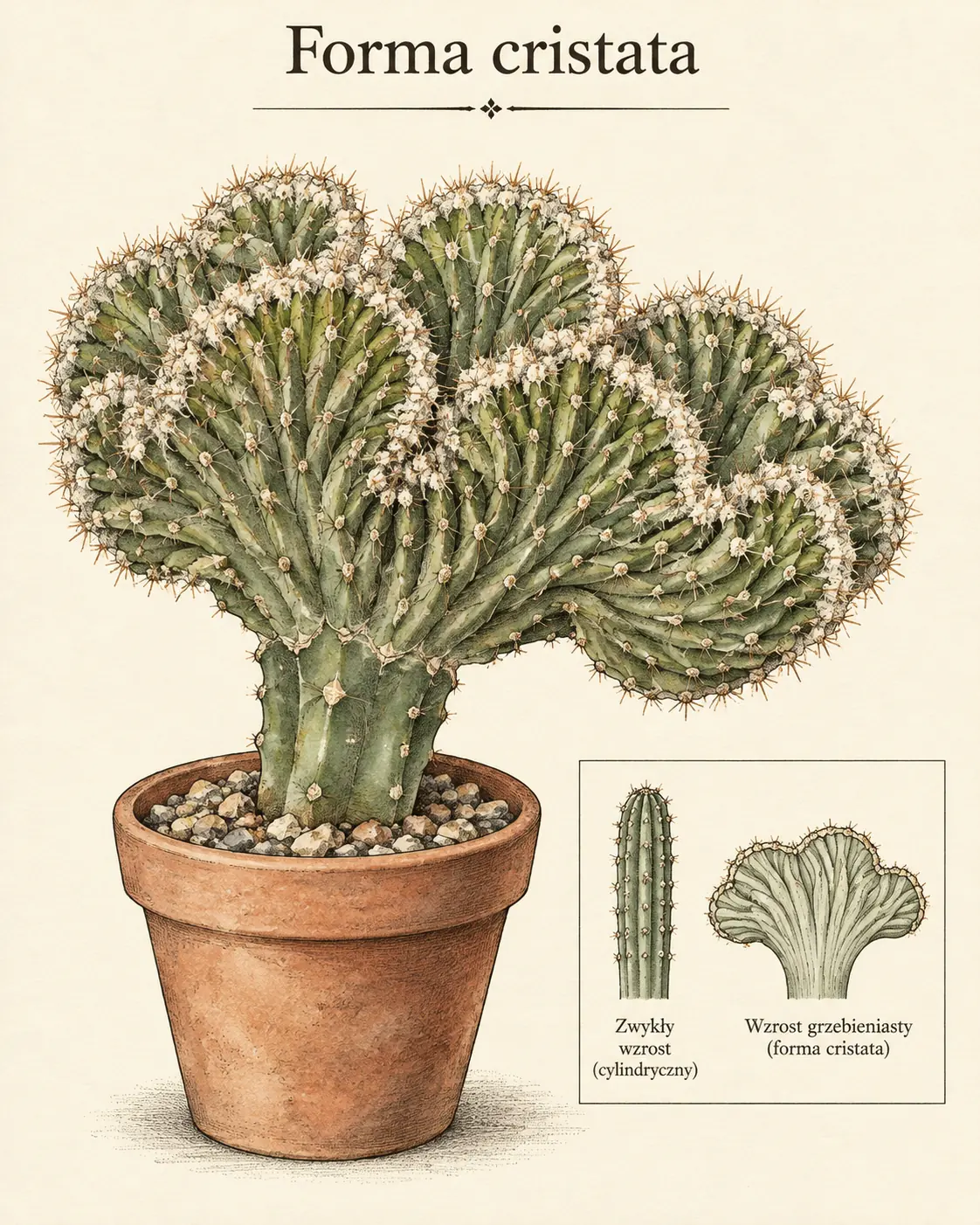
At BA 19,9 and 26,6 µM, the authors observed crested and monstrose shoots, described in the paper as fasciated, alongside shoots of ordinary form. Their appearance at the two higher cytokinin concentrations is an important qualitative result. A higher BA dose did not significantly increase the number of multiplying shoots and co-occurred with changes in their organisation and lower average length. Assessment of propagation efficiency therefore includes shoot number, form and subsequent development. [Arellano-Perusquía et al. 2013, pp. 163–165, Table 2, Discussion]
In the discussion, the authors relate fasciation to the effects of growth regulators and generally known mechanisms regulating the meristem, including genes of the CLAVATA family. This comment is an interpretation based on earlier literature. The experiment with O. macdougallii did not determine expression of these genes, persistence of the character after transfer to a substrate or the contribution of genetic changes. The occurrence of different shoot forms in specific culture treatments is documented. Their molecular cause and subsequent stability remain to be tested. [Arellano-Perusquía et al. 2013, pp. 164–165, Discussion]
A separate stage of root formation
Rooting was studied for 50 days in four treatments. Quarter-strength or half-strength MS medium without regulators was used, as well as half-strength MS with IBA, indole-3-butyric acid, at 1,6 or 4,9 µM. Each treatment comprised eight vessels containing three explants each. Root primordia were visible after approximately 30 days and clearly elongated after a further 20 days. Roots formed without preceding callus formation. [Arellano-Perusquía et al. 2013, pp. 161, 164, Rooting, Results]
| Medium | Forming roots (%) | Number of roots | Root length (mm) |
|---|---|---|---|
| ¼ MS, without regulators | 58,34 ± 8,34 | 4,17 ± 0,48 | 11,32 ± 1,95 |
| ½ MS, without regulators | 37,49 ± 11,68 | 5,00 ± 1,37 | 9,96 ± 3,05 |
| ½ MS + IBA 1,6 µM | 45,83 ± 6,11 | 6,33 ± 0,77 | 8,99 ± 0,91 |
| ½ MS + IBA 4,9 µM | 75,03 ± 5,45 | 9,92 ± 1,91 | 8,37 ± 1,56 |
The highest mean proportion of shoots forming roots and the highest root number were obtained on half-strength MS with IBA 4,9 µM. Compared with half-strength MS without regulators, the increase in the proportion of rooted shoots was statistically significant. The quarter-strength MS treatment partly overlapped both groups in Tukey's test. Similarly, IBA 1,6 µM did not give a clear advantage over both controls. Mean root length remained statistically similar across all treatments. The concentration that increased the proportion of rooted shoots and their root numbers therefore did not increase the demonstrated root length. [Arellano-Perusquía et al. 2013, p. 164, Table 4, homogeneous-group letters from Tukey’s test]
The original table 4 gives a printed unit of mM for IBA, while the rooting methods description and corresponding results text give µM. The compilation above retains the unit from the experimental description. The discrepancy involves a factor of one thousand and therefore matters for interpreting the protocol. The values presented describe the laboratory study and its scope of medium comparison. [Arellano-Perusquía et al. 2013, p. 161, Rooting; p. 164, results text and Table 4]
Significance for propagation and resource conservation
The paper documents production of new shoots from fragments of nursery plants and their rooting in culture. Material can arise through areole activation and direct adventitious organogenesis, and regulator selection affects the contribution of these responses and shoot form. For a species with a narrow range, this multiplication method provides a basis for developing a cultivated source of plants. Assessing its usefulness in conservation also requires representation of different starting plants, maintenance of their identity and monitoring of subsequent developmental stages. [Arellano-Perusquía et al. 2013, pp. 160–161, 165, Introduction, Discussion]
The endpoint of the experiments described was a plant with a shoot and roots obtained in vitro. Acclimatisation and subsequent growth outside the vessel are a separate stage of propagation. [Arellano-Perusquía et al. 2013, pp. 161, 164–165, scope of the method and rooting results]
Effect of growth regulators on the organogenesis and multiplication of Ortegocactus macdougallii Alexander
Arellano-Perusquía A., López-Peralta M. C. G., Chablé-Moreno F., Estrada-Luna A. A., Effect of growth regulators on the organogenesis and multiplication of Ortegocactus macdougallii Alexander, Propagation of Ornamental Plants, 2013, 13(4):160-167
Experiments on micropropagating Ortegocactus macdougallii from tubercles of adult plants. The authors observe activation of areole meristems and adventitious bud formation outside areoles. They compare BA and NAA combinations during initiation and multiplication, and MS medium dilution and IBA during rooting. Higher BA doses were associated with fasciation in some shoots, and the highest proportion of rooted explants was about 75% after 50 days.
Plants of the World Online — Royal Botanic Gardens, Kew
Accepted names, synonyms and distribution. A citation beside a taxon leads to its record.
Accessed 2026-10-08.
Molecular phylogeny of the Mammilloid clade (Cactaceae) resolves the monophyly of Mammillaria
Breslin P. B., Wojciechowski M. F., Majure L. C., Molecular phylogeny of the Mammilloid clade (Cactaceae) resolves the monophyly of Mammillaria, Taxon, 2021, 70(2):308-323, doi: 10.1002/tax.12451
A reconstruction of mammilloid clade phylogeny from the large single-copy region of the plastid genome, using maximum likelihood, maximum parsimony and Bayesian inference. The sample contains 88 specimens representing 78 taxa, and the analysis is supported by morphological character state reconstructions. The authors propose new boundaries for Mammillaria, Cochemiea and Coryphantha and discuss the separate position of Mammillaria sphacelata, now Oehmea sphacelata.