Huernia pillansii
Name and relationships
The name accepted in POWO is Huernia pillansii N.E.Br., published in 1904. The species belongs to the dogbane family, Apocynaceae. Newer publications may use Ceropegia pillansii (N.E.Br.) Bruyns, established in 2017. In the POWO treatment used here, it remains a synonym. [2-WWW]
Stem and flower structure
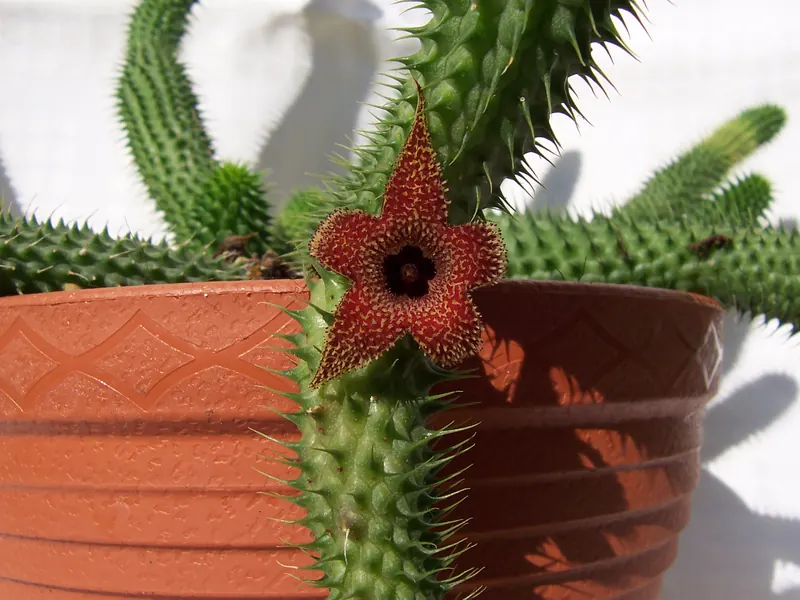
The mature stem is cylindrical, with tubercles arranged in 10–16 rows. Their elongated, bristle-like tips are 2–8 mm long. The number of edges increases during development. The youngest section may be four-angled, while the older part develops many more, less distinct rows of tubercles. [19-WWW]
Fleshy flowers appear at the base of young growth and reach about 4 cm in diameter. The corolla is deeply divided, with red or carmine spots and papillae covering its pale background. RHS reports flowering from summer to early autumn under British cultivation conditions with shelter. [1-WWW]
Habitats in the Karoo
Floristic descriptions associate the species with the Little Karoo and southwestern Great Karoo. Reported sites extend eastwards from the areas around Montagu and Touws River to Camfers Poort, northwest of Steytlerville. Plants occupy stony sites, often beneath low shrubs, on rocky plains and gentle or locally steeper slopes. [19-WWW]
Cultivation and propagation
RHS recommends bright, diffused light and a freely draining cactus substrate with added leaf mould. Watering is moderate during growth, and the substrate is kept almost dry in winter. A diluted fertiliser with low nitrogen content can be applied monthly during the season. Excess water increases the risk of rot. [1-WWW]
Stem cuttings are taken in spring or summer. RHS gives a temperature of 19–24°C for sowing. These are horticultural propagation recommendations, dependent on substrate conditions and moisture management. [1-WWW]
Synonyms and names in the literature
Ceropegia pillansii [2-WWW]