Stems, roots and flowers
New plates with panel explanations and references to the literature.
Schematic illustrations from the supplied materials. Captions identify the scope of simplifications and any inaccuracies. Clicking an image opens it at full size.
Showing 1–12 z 23 results

Stem cross-section
The plate shows the organisation of a fleshy stem. Green around the perimeter marks the photosynthetic region, and the pale tissue deeper inside marks the water storage region. The vascular system surrounds the pith. [Mauseth 2006]
This is a structural model. Tissue proportions, continuity of the hypodermal layer and distribution of additional bundles in the cortex vary among cacti.
Enlarge plate ↗
Ribs, tubercles and stem form
Two rows of panels compare rib direction, number, width and degree of division into tubercles. These traits help describe stem appearance and changes during growth. [Mauseth 2006] [Hernández-Hernández et al. 2011]
The plate labels combine different descriptive criteria. Segmentation of the whole stem is not a rib type, and tubercles do not form a single simple evolutionary series from ribs. This comparison is not a formal classification.
Enlarge plate ↗
Root architecture
The plate combines a whole-plant view with a comparison of root spread and thickening. Two smaller panels show the general route from the root surface through the cortex and endodermis to vascular tissues, and the role of root hairs in contact with the substrate. [Dubrovsky and North 2002] [Dubrovsky et al. 1998]
Internal structure is shown schematically. A taproot is not always deep, and “crevice” describes its position in the substrate. Architecture also depends on age, rainfall, damage and container conditions.
Enlarge plate ↗
Six views of root systems
The upper row compares an extensive shallow system, a dominant main root and roots that store resources. The lower row shows a mixed system, growth in crevices and shallow spreading Opuntia roots. [Dubrovsky and North 2002]
These are examples of architecture, not six mutually exclusive taxonomic categories. A plant may combine several of the traits shown, and lengths and depths are not drawn to scale.
Enlarge plate ↗
Flower, ovary, fruit and seeds
The central drawing identifies the perianth, stamens, stigma, style and ovary. Side panels cover the flower interior, pollen, fruit and seeds. The lower strip compares general flower shapes. [Rosas-Reinhold et al. 2021] [Ramírez-Castro et al. 2024] [González et al. 2023]
The plate requires anatomical correction when interpreting details. The partitions drawn in the ovary section do not represent the unilocular ovary with parietal placentation typical of cacti. Stamens surround the style and are not part of it. The pollen and seed scales and the fruit shown do not document a single identified species.
Enlarge plate ↗
Areoles, buds and a flower on the stem
The drawing shows areole distribution on the ribs and their connection with spines and lateral stem structures. An areole meristem may participate in the development of a branch or floral structure. A closed bud is shown next to an open flower. These are different structures shown in one diagram, without assignment to an identified species. [Mauseth 2006] [Rosas-Reinhold et al. 2021]
The label “spines” refers to the elongated, sharply pointed elements, not the pale hairs in the centre of the areole. The green bud labelled “offset” represents the drawing's intended interpretation. Its outline alone does not document developmental identity or internal structure.
Enlarge plate ↗
Temperature of the stem and its surroundings
The drawing highlights different locations where temperature can be measured, including the air, stem surface, stem interior and root zone. Sensor location is part of the measurement description. [Nobel and Hartsock 1984] [Mauseth 2006]
No experimental details or source for the values shown on the plate were provided. The numbers and scales are not verified data and do not define safe cultivation temperatures. The cited literature supports the physiological explanation, not the origin of these numbers.
Enlarge plate ↗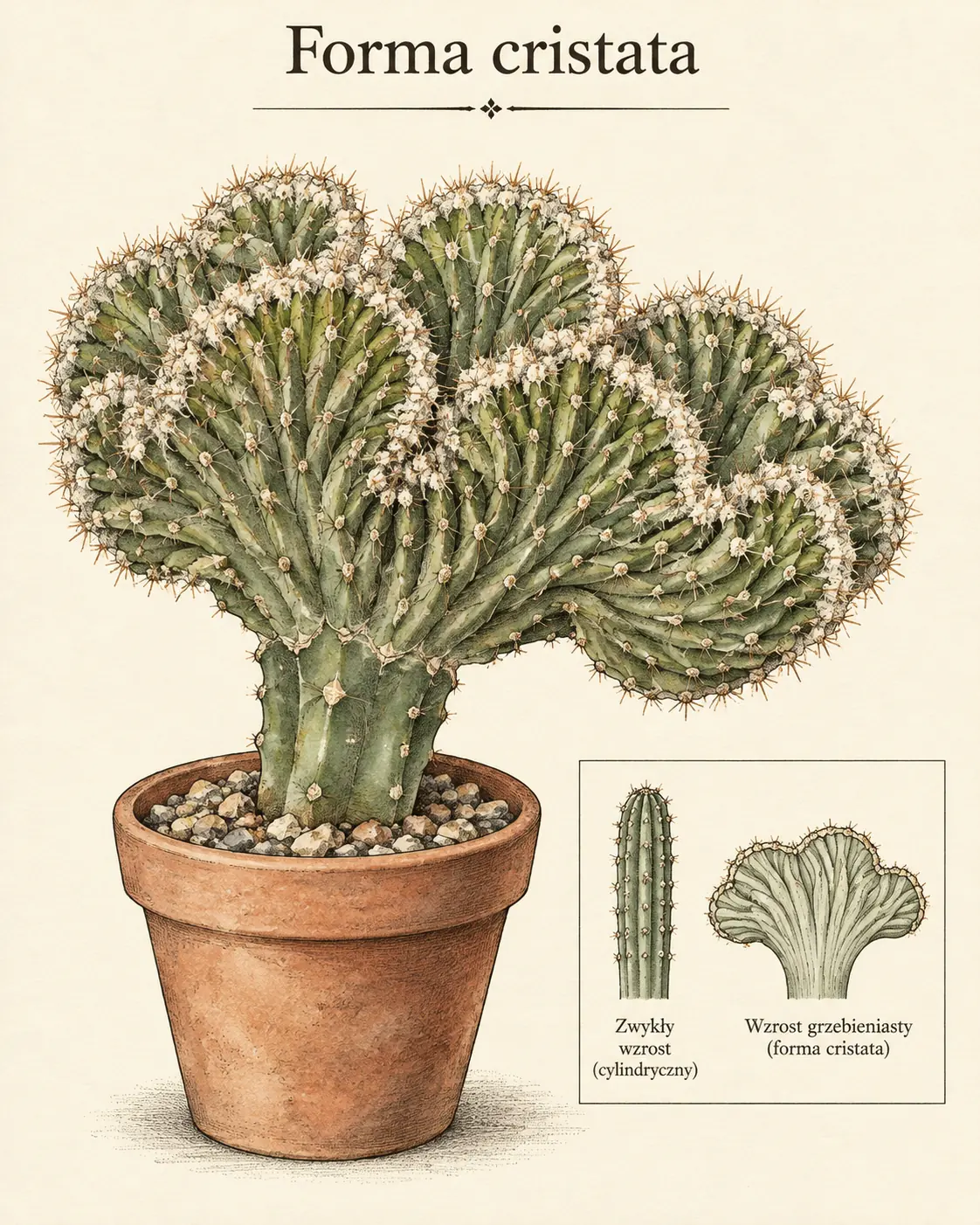
Cristate form
A flattened, folded stem illustrates growth along an elongated apical zone. [Iliev and Kitin 2011] [Fleischer and Schütz 1978]
The drawing describes a growth form. It does not identify the species or cause of fasciation.
Enlarge plate ↗
Monstrous form
Irregular growth and branching illustrate a monstrose form. [Fleischer and Schütz 1978] [Hinz and Abramowicz 1986]
The phrase “lack of symmetry” is a simplification. Altered and regular sections may coexist.
Enlarge plate ↗
Tubercle shape and distribution
The comparison combines tubercle shape, tip form and density of distribution. [Britton and Rose 1923] [Mauseth 2006]
The traits are not mutually exclusive. The images are not portraits of identified species. Botanical examples are described in the text.
Enlarge plate ↗
Short-conical
Schematic trait. Short-conical. Example and scope of comparison. Mammillaria mammillaris. [Britton and Rose 1923] [2-WWW]
The drawing is a geometric model without a scale or identified specimen. It is not used to identify the species.
Enlarge plate ↗
Elongated conical
Schematic trait. Elongated. Example and scope of comparison. Mammillaria longimamma. [Britton and Rose 1923] [2-WWW]
The drawing is a geometric model without a scale or identified specimen. It is not used to identify the species.
Enlarge plate ↗