Cultivation and propagation
New plates with panel explanations and references to the literature.
Schematic illustrations from the supplied materials. Captions identify the scope of simplifications and any inaccuracies. Clicking an image opens it at full size.
Showing 1–12 z 30 results

Hand pollination
A brush transfers pollen from the anther to the stigma. Further development requires pollen germination and compatibility between partners. [Fleischer and Schütz 1978] [González et al. 2023]
This is a pollination diagram and does not establish fertilisation. The amount of pollen shown is schematic.
Enlarge plate ↗
Light and supplementary lighting
The plate compares a window, distance from it and additional lighting. [15-WWW] [Fleischer and Schütz 1978]
Centimetres and watts in the drawing are not universal recommendations. Actual exposure is determined by light measurements and site conditions. Rotation practices require consideration of acclimatisation.
Enlarge plate ↗
Root arrangement during planting
On the left, the roots fit without bending back. On the right, they are crowded in an unsuitable container. [Woźniak n.d.] [Rutgers New Jersey Agricultural Experiment Station b.d.] [6-WWW]
The lower layer of coarse material in the drawing does not establish effective drainage. Water outflow depends on the properties of the entire root ball and container.
Enlarge plate ↗
Roots in water culture
A stem supported above a nutrient solution, with some roots in the liquid. A transparent vessel allows the arrangement to be shown. [7-WWW] [6-WWW]
The diagram does not show a complete installation. Oxygen supply, nutrient solution control and reduced light in the reservoir are needed.
Enlarge plate ↗
Seedlings under cover
Small seedlings under a transparent cover that reduces evaporation. [Fleischer and Schütz 1978]
This is a mini greenhouse for sowing. Ventilation and exposure are adjusted to seedling development. The cover does not replace temperature control.
Enlarge plate ↗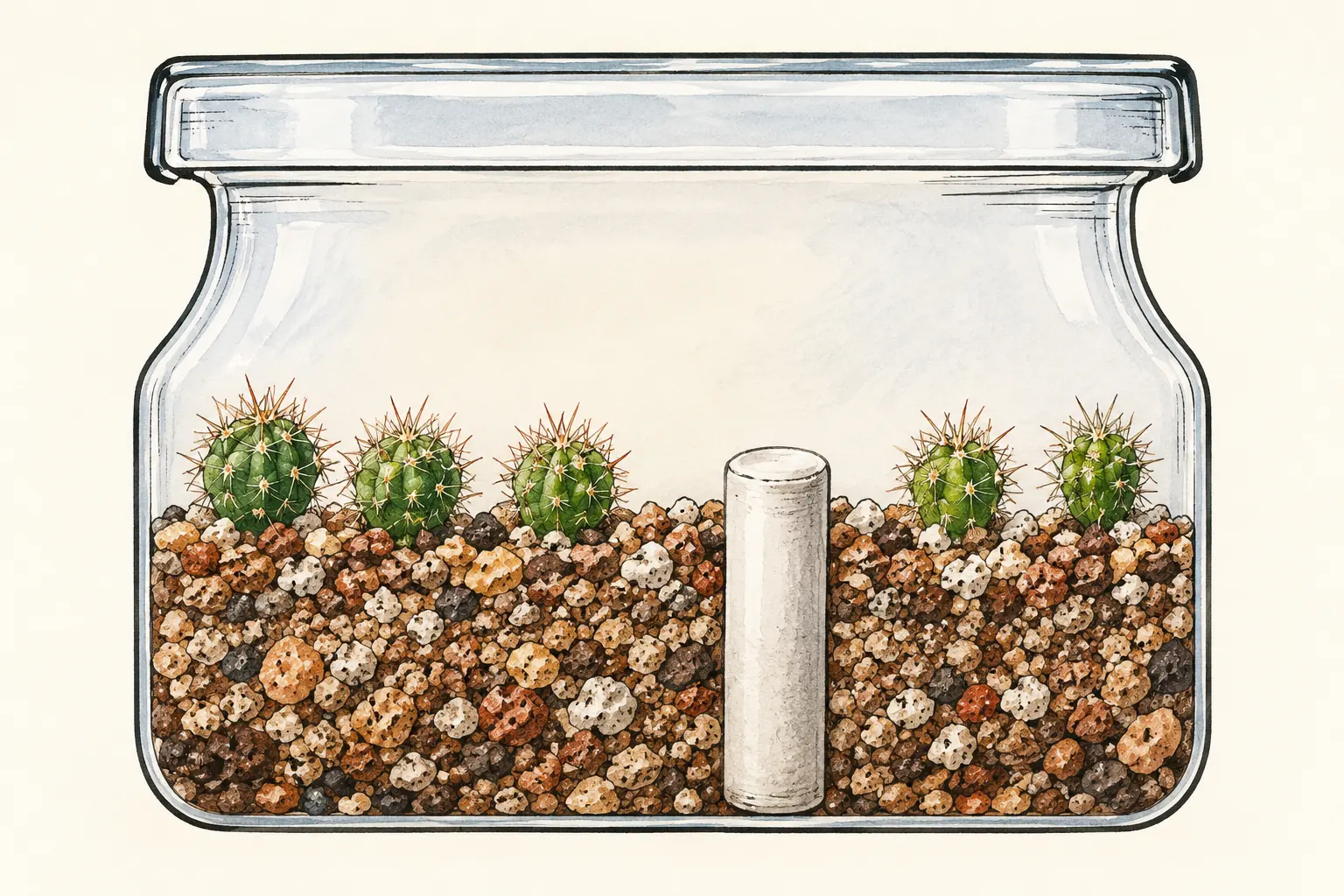
Sowing in a closed container
A closed container maintains a moist environment around the sowing. [Fleischer and Schütz 1978]
Closure does not guarantee sterility. The visible condition of seedlings does not determine when the container should be opened.
Enlarge plate ↗
Flat grafting
Successive stages of preparing the rootstock and scion, bringing the cut surfaces together and securing them. The vascular regions of both stems should have points of contact. [Fleischer and Schütz 1978] [Wang et al. 2024] [Anonim b.d.ac]
Proportions and rings are schematic. Scion position is adjusted to the actual tissue arrangement, and pressure maintains contact without crushing the tissues.
Enlarge plate ↗
Cleft grafting
The lower part of the scion is shaped into a wedge matching the incision in the rootstock. The adjoining surfaces are kept in constant contact during healing. [Fleischer and Schütz 1978] [Wang et al. 2024] [Anonim b.d.ac]
A cover reduces water loss and requires ventilation and protection from overheating. Its use depends on scion size and healing conditions.
Enlarge plate ↗
Micrografting a seedling onto Pereskiopsis
A small seedling fragment is joined to a fresh cut on an active Pereskiopsis rootstock. A transparent cover may reduce drying of the small scion. [Fleischer and Schütz 1978] [Wang et al. 2024] [Anonim b.d.ac]
The lower part of the seedling is removed to create a fresh contact surface. The scion is positioned so that its vascular region touches that of the rootstock. Placement follows the anatomy of both cross-sections and may require an offset from the centre.
Enlarge plate ↗
Mealybugs on the stem
Mealybugs and wax secretion in stem depressions. Schematic illustration. [1-WWW]
Enlarge plate ↗
Mealybugs in the root ball
Root mealybugs and clusters of wax secretion in an exposed root ball. Schematic illustration. [17-WWW]
Enlarge plate ↗
Spider mites and webbing
Spider mites, eggs and webbing on the stem surface. Schematic illustration. [1-WWW]
Enlarge plate ↗