Stem and root mealybugs
Mealybugs produce a whitish waxy secretion and hide in stem recesses, between offsets or beneath tissue remnants. Inspection must reveal the insect's body or developmental stages. Natural areole wool is not evidence of infestation. Honeydew may promote sooty mould. When growth is poor and no insects are present on the stem, the roots and inside of the container are also checked. [1-WWW] [Fleischer and Schütz 1978, pp. 189–192]

Mealybugs on the stem
Mealybugs and wax secretion in stem depressions. Schematic illustration. [1-WWW]
Enlarge plate ↗Root mealybugs belonging to Rhizoecus are not aphids. EPPO places Rhizoecus falcifer in the family Rhizoecidae. The old broad terms “root aphid” or “root louse” are insufficient to identify a pest. A changed name in a book does not justify identifying every white insect in the root ball as this single species. [17-WWW] [Hinz and Abramowicz 1986, pp. 108–111]

Mealybugs in the root ball
Root mealybugs and clusters of wax secretion in an exposed root ball. Schematic illustration. [17-WWW]
Enlarge plate ↗The plant is separated from the collection, accessible insects are removed without wounding the epidermis, and subsequent growth and the root ball are inspected. Heavily infested material of little value can be removed with the contaminated substrate. Greenhouses use, among other agents, the ladybird Cryptolaemus montrouzieri, but effectiveness depends on temperature, population size and mealybug type. It is not an automatic means of controlling all root pests. [1-WWW]
The checked Polish Sanium AL label includes scale insects on ornamental plants indoors and under cover. It specifies spraying, so does not authorise drenching the root ball against root mealybugs. Identifying a “mealybug” also does not remove the need to check the application site, plant species, treatment tolerance and the entire label. [10-WWW]
Spider mites and other mites
Small areas of discolouration, a dull appearance and damage to the young stem surface may indicate mites. The two-spotted spider mite, Tetranychus urticae, is not always red. Webbing may become obvious only with a larger population. The absence of visible webbing does not rule out feeding. A magnifying glass and observation of living stages are needed. Older books grouped different mites under the common name “red spider”. [1-WWW] [Fleischer and Schütz 1978, pp. 189–190]

Spider mites and webbing
Spider mites, eggs and webbing on the stem surface. Schematic illustration. [1-WWW]
Enlarge plate ↗The predatory mite Phytoseiulus persimilis is used against spider mites under suitable conditions in protected cultivation. Thus, not every red mite is a pest. Higher humidity alone does not eliminate a population, and constantly wetting cacti can create a separate cultivation problem. Chemical protection requires confirmation that the product label includes the relevant mite. The word “insecticide” and an old sulphur recommendation do not establish this. [1-WWW] [10-WWW] [Fleischer and Schütz 1978, pp. 189–190]
Armoured scales, soft scales and aphids
Armoured scales and soft scales differ in the structure of their coverings and their biology. An immobile scale cover must be distinguished from a scar, and an organism sought beneath it. Juvenile stages can move. Aphids more often gather on tender growth, leaves of leafy cacti and buds. Honeydew, shed skins and the presence of insects help distinguish feeding from a colour change alone. [1-WWW] [Fleischer and Schütz 1978, pp. 190–192] [Seneta b.d., pp. 99–104]

Armoured scale covers
Armoured scale covers on a cactus stem. Schematic illustration. [1-WWW]
Enlarge plate ↗
Soft scales and honeydew
Convex soft scales and honeydew drops on the stem. Schematic illustration. [1-WWW]
Enlarge plate ↗
Aphids on a bud
Aphids on delicate bud tissues. Schematic illustration. [1-WWW] [Fleischer and Schütz 1978]
Enlarge plate ↗Removing small colonies and isolating plants limit the source of further infestation. A contact treatment must reach the organism and may miss hidden stages. Its outcome is therefore assessed through later inspections, and treatments repeated only at the intervals and frequency permitted by the label. Mospilan 20 SP has checked minor uses in ornamental plants, but the current product is intended for professional users. [1-WWW] [10-WWW]
Fungus gnats, thrips and substrate pests
Adult fungus gnats flying above the substrate signal a need to check its moisture and the presence of larvae. Larvae are particularly important around delicate roots and seedlings. Sticky traps help monitor adults, but catching them does not prove that larvae have been eliminated. Substrate hygiene and avoiding a constantly wet surface should suit the seedlings' developmental stage without drying them out. [9-WWW] [Fleischer and Schütz 1978, pp. 192–193]
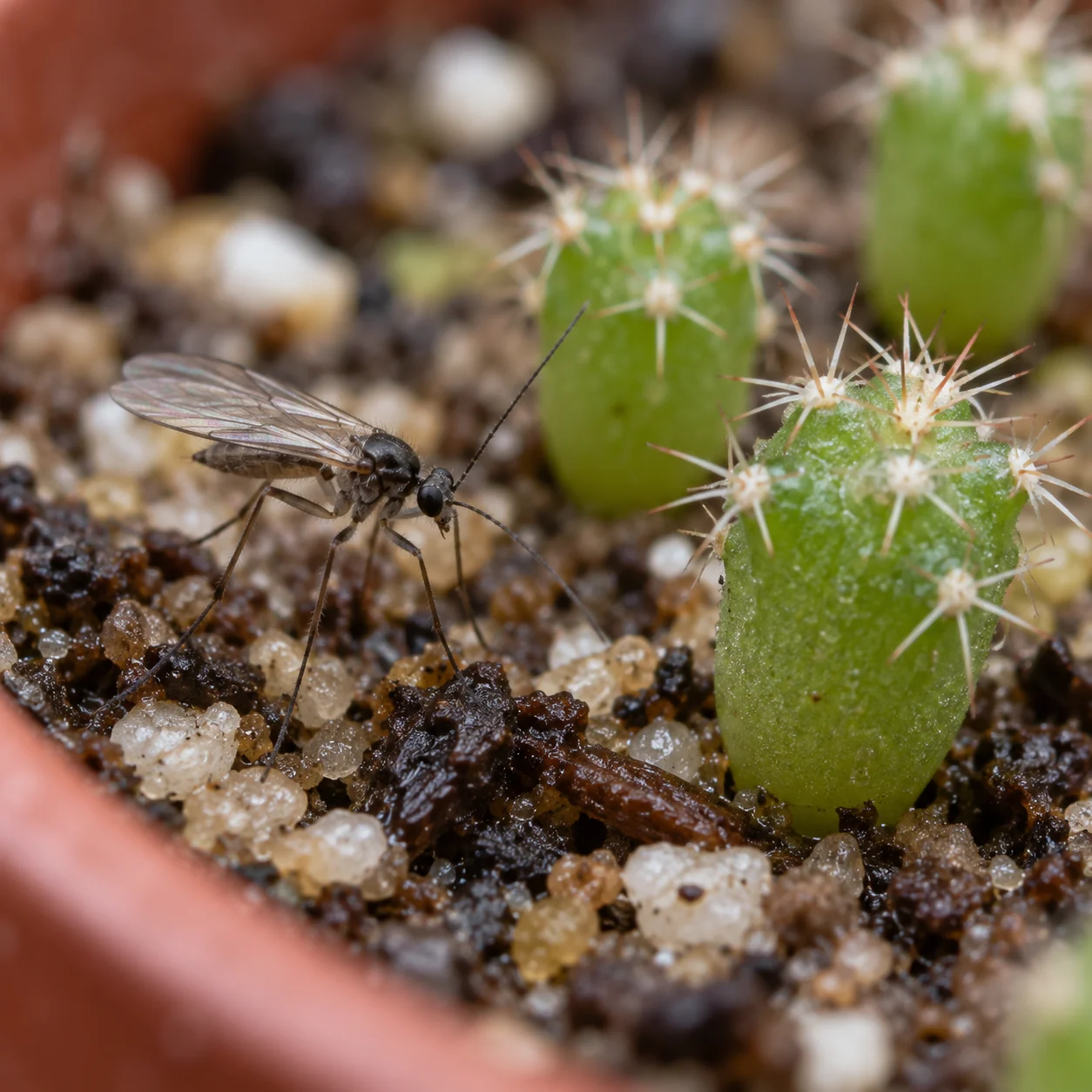
Adult fungus gnat near a sowing
Adult fungus gnat above substrate with seedlings. Schematic illustration. [Fleischer and Schütz 1978] [9-WWW]
Enlarge plate ↗Thrips can damage young tissues and flowers, and signs of their feeding need to be distinguished from abrasions and mite damage. Root-parasitic nematodes are identified differently from insects. Swellings may justify testing roots, but do not automatically indicate one nematode species. The historically described cactus cyst nematode, Heterodera cacti, is not equated with the root-knot nematode Meloidogyne simply because both damage roots. [Fleischer and Schütz 1978, pp. 192–193] [Seneta b.d., pp. 102–105]

Thrips on a bud
Thrips on a flower bud. Schematic illustration. [Fleischer and Schütz 1978] [Seneta b.d.]
Enlarge plate ↗Infested cuttings are not introduced into a collection, and uncleaned containers from an infestation are not reused. Biological methods against larvae and nematodes are selected for the identified organism and substrate conditions. Historical fumigants and nematicides in a book are not instructions for treating a pot occupied by a plant. [9-WWW] [Fleischer and Schütz 1978, pp. 192–193]
Checking the result
A new plant is inspected before joining the collection and observed in isolation. After control measures, further inspections examine new growth, recesses and roots if these were the pest's location. Old scars remain visible even after successful treatment, so the presence of living stages and the appearance of new damage determine the outcome. [1-WWW] [Fleischer and Schütz 1978, pp. 189–193]
A product is selected for the organism, plant, cultivation site and current scope of authorisation. Concentration is not increased beyond the label in response to failure. Before another treatment, identification, plant coverage, hidden stages and the possibility of reintroduction are checked. A detailed update of product names is provided in the table of historical and current plant protection products. [10-WWW] [Seneta b.d., pp. 99–104]
Cactoblastis larvae inside stem segments
The moth Cactoblastis cactorum lays eggs in elongated rows resembling spines. Young larvae enter a stem segment together and feed inside its tissues. After feeding, they leave the plant and pupate in litter or soil. The 2000 review by Zimmermann, Moran and Hoffmann discusses this biology in the context of deliberate introductions against invasive prickly pears. [Zimmermann et al. 2000]

Caterpillars inside a segment
Group feeding by Cactoblastis cactorum caterpillars inside an Opuntia segment. Schematic illustration. [Zimmermann et al. 2000]
Enlarge plate ↗The same feeding behaviour can damage native and cultivated prickly pears. The paper compares successes in suppressing introduced cacti with threats to native flora where the moth has appeared. Predicting outcomes requires considering local hosts, climate and the insect's natural enemies. The article's geographical description of distribution reflects knowledge in 2000. [Zimmermann et al. 2000]
Prepared from the cited studies and supplied book excerpts. Historical names and recommendations are distinguished from current findings. The extent of access to each publication is stated in the bibliography.
Kaktusy
[Fleischer Z., Schütz B., Kaktusy, Państwowe Wydawnictwo Rolnicze i Leśne, Warszawa, 1978, wyd. I, trans. Kabiesz Z., Prajer Z.]
Państwowe Wydawnictwo Rolnicze i Leśne, Warsaw, first edition. Translated by Zofia Kabiesz and Zbigniew Prajer. Historical and cultivation background. Names and interpretations updated separately.
Kaktusy
[Seneta W., Kaktusy, b.d., s. 99–111 (udostępniony fragment)]
The supplied book extracts come from Konrad Szychowski's private archive. The chapters describe cactus diseases, pests and damage, and historical methods of plant protection. The year and edition of this copy remain undetermined.
Uprawa kaktusów
[Hinz S., Abramowicz M., Uprawa kaktusów, Wydawnictwo Glob, Szczecin, 1986, s. 28–32, 89–112 (udostępnione fragmenty)]
The guide covers cactus structure, growth forms, propagation, cultivation conditions and plant protection. Supplied excerpts describe crested and monstrose forms, winter hardiness, and identification of damage and diseases, among other subjects. Plant protection recommendations document practice at the time of publication.
Royal Horticultural Society
Cultivation and plant protection guides. Horticultural recommendations are read with attention to species and cultivation conditions.
Accessed 2026-10-08.
University of California Integrated Pest Management
Identification of plant problems and principles of integrated pest management.
Accessed 2026-10-08.
European and Mediterranean Plant Protection Organization — Global Database
Nomenclature and classification of organisms associated with plant health.
Accessed 2026-10-09.
Portal administracji publicznej — Ministerstwo Rolnictwa i Rozwoju Wsi
The official plant protection product search and links to current labels.
Accessed 2026-10-08.
The renowned cactus moth, Cactoblastis cactorum: Its natural history and threat to native Opuntia floras in Mexico and the United States of America
Zimmermann H. G., Moran V. C., Hoffmann J. H., The renowned cactus moth, Cactoblastis cactorum: Its natural history and threat to native Opuntia floras in Mexico and the United States of America, Diversity and Distributions, 2000, 6(5):259-269, doi: 10.1046/j.1472-4642.2000.00088.x
A review of the biology of Cactoblastis cactorum and the history of its use to control invasive prickly pears. It discusses egg laying, group feeding by larvae inside cladodes, host range and historically recognised threats to native cacti in the Americas.

