The species in the experiment
Malik and colleagues studied Copiapoa gigantea (in the 2015 and 2016 publications, C. cinerea var. haseltoniana). The current name corresponds to the taxon also called C. haseltoniana. Linking these names allows the experiment to be assigned to the appropriate profile, rather than extended to all plants called C. cinerea. [Larridon et al. 2018][Malik et al. 2015][Malik et al. 2016]
Dew forms by condensation of water vapour on a cooled surface. Fog consists of droplets suspended in air, which can settle on a plant. The 2015 studies compared the amount of dew retained by four species, while the 2016 experiment concerned subsequent droplet movement along spines. [Malik et al. 2015][Malik et al. 2016]
What was recorded
After a night with dew, six visible spines on one young plant were observed. Photographs were taken every two minutes for half an hour, after sheltering the plant from direct sun and wind. Droplets moved towards the spine bases. Estimated speeds ranged from about 5.18 to 16.2 mm per hour. Some recorded trajectories opposed the direction of gravity. [Malik et al. 2016, methods and results, time-lapse sequences]
The number six refers to spines on one plant. The measurement describes movement in a particular observation setup. Surface geometry, droplet size, wetting and spine orientation jointly determine the direction and rate of movement. [Malik et al. 2016]
Cone, grooves and pressure in a droplet
A spine broadens from tip to base. A droplet adhering to a conical surface has different curvature at its two ends. Laplace pressure is associated with the curvature of the water–air interface. Asymmetry can generate a force directed along the spine axis towards the wider part. If this force is large enough, movement also occurs along an ascending section. [Malik et al. 2016, discussion of the mechanism]
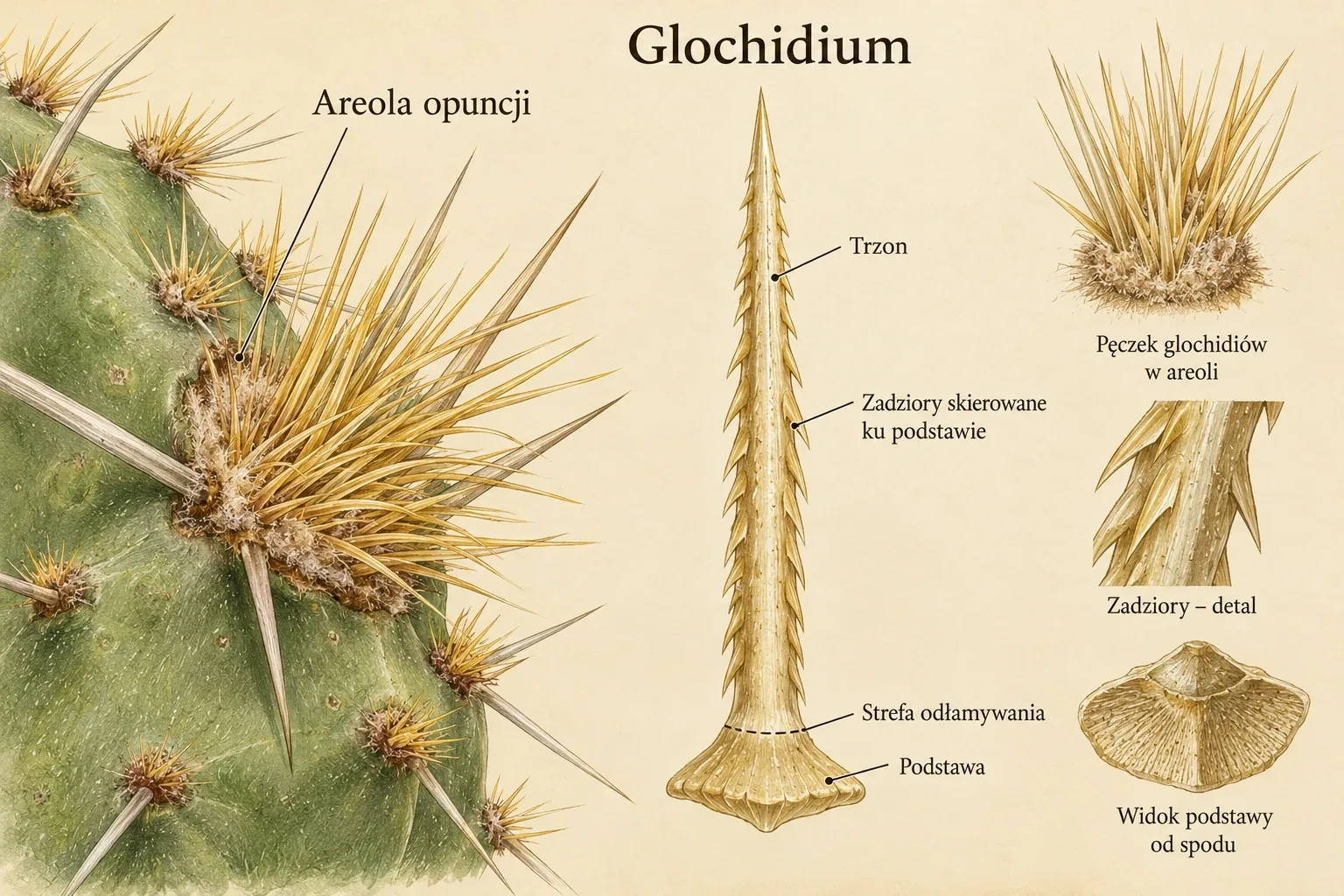
Microscopy revealed longitudinal microgrooves and a hierarchical surface structure. Groove geometry and changes in roughness affect wetting and contact between liquid and spine. The authors interpreted directional movement as the combined effect of macroscopic shape and finer-scale structure. Separating the contribution of each factor requires comparisons of controlled surfaces. [Malik et al. 2016]
The route from spine to tissues
In an additional experiment, water was labelled with fluorescent nanoparticles about 20 nm in size. Only the spines contacted the liquid for an hour, with the areoles kept outside it. Fluorescence was subsequently detected in stem cortical tissues. The result supports the possibility of water entry through this route under the experimental conditions. [Malik et al. 2016, tracer experiment]
Magnetic resonance imaging revealed water-containing regions inside the stem. This provides a complementary picture of water distribution in tissues. A static image alone does not measure its movement speed, so directional transport on the surface and the presence of water inside are two separate elements of the documentation. [Malik et al. 2016]
Relevance to water balance
Movement towards the areole can concentrate water from a larger spine surface at its base. However, the contribution of this route to the overall water balance depends on the amount of condensate, frequency of dew formation, evaporation losses and uptake efficiency. The studies describe the mechanism and its occurrence in the material studied. Its quantitative importance in field populations remains a separate question. [Malik et al. 2015][Malik et al. 2016]
Plant structure, flower traits and historical names are compared in the profile of Copiapoa gigantea. Stem inclination in this species was previously studied under the name C. haseltoniana, providing a second documented example of a relationship between structure and microclimate. [Larridon et al. 2018][Ehleringer et al. 1980]
Hierarchical structures of cactus spines that aid in the directional movement of dew droplets
Malik F. T., Clement R. M., Gethin D. T., Kiernan M., Goral T., Griffiths P., Beynon D., Parker A. R., Hierarchical structures of cactus spines that aid in the directional movement of dew droplets, Philosophical Transactions of the Royal Society A, 2016, 374(2073):20160110, doi: 10.1098/rsta.2016.0110
The authors track droplet movement along the spines of Copiapoa gigantea, described in the paper as C. cinerea var. haseltoniana. Microscopy, labelling water with nanoparticles and imaging the stem interior allow them to discuss spine geometry and a possible route for water entry into the plant.
Investigating taxon boundaries and extinction risk in endemic Chilean cacti (Copiapoa subsection Cinerei, Cactaceae) using chloroplast DNA sequences, microsatellite data and 3D mapping
Larridon I., Veltjen E., Semmouri I., Asselman P., Guerrero P. C., Duarte M., Walter H. E., Cisternas M. A., Samain M. S., Investigating taxon boundaries and extinction risk in endemic Chilean cacti (Copiapoa subsection Cinerei, Cactaceae) using chloroplast DNA sequences, microsatellite data and 3D mapping, Kew Bulletin, 2018, 73(4):55, doi: 10.1007/s12225-018-9780-3
The paper compares chloroplast sequences, microsatellite markers and population mapping in the Copiapoa cinerea group. It includes detailed descriptions of C. cinerea and its subspecies and C. gigantea, with an analysis of their separation and ranges.
Dew harvesting efficiency of four species of cacti
Malik F. T., Clement R. M., Gethin D. T., Beysens D., Cohen R. E., Krawszik W., Parker A. R., Dew harvesting efficiency of four species of cacti, Bioinspiration & Biomimetics, 2015, 10(3):036005, doi: 10.1088/1748-3190/10/3/036005
The field experiment compares the amount of dew retained by four cactus species with a reference surface. Observations of droplet distribution on stems and spines complement microscopic measurements of their surfaces.
Orientation and its consequences for Copiapoa (Cactaceae) in the Atacama Desert
Ehleringer J., Mooney H. A., Gulmon S. L., Rundel P., Orientation and its consequences for Copiapoa (Cactaceae) in the Atacama Desert, Oecologia, 1980, 46(1):63-67, doi: 10.1007/BF00346967
The field study measures stem orientation and inclination in three historically recognised Copiapoa taxa, and their surface temperatures. A radiation balance model explains how northward orientation of the apex relates to warming of the growth and flowering zone.